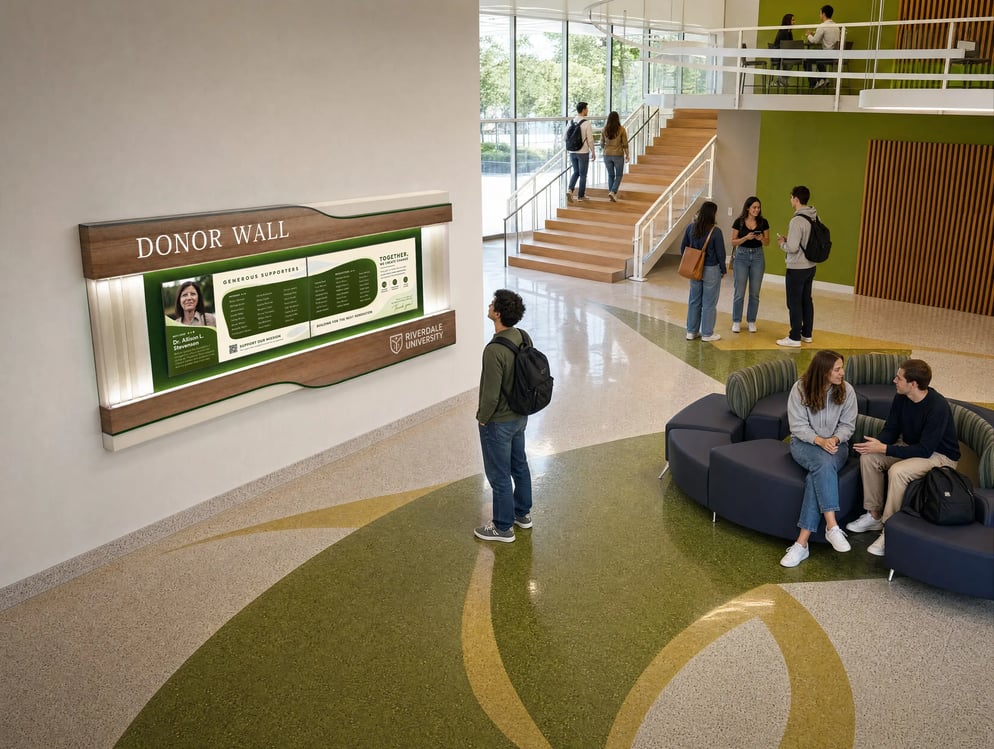
University donor recognition is how a college or university honors the alumni, families, faculty, and organizations whose gifts fund scholarships, buildings, programs, and athletics: giving societies and a legacy society, named spaces and naming opportunities, the annual report, and a donor wall on campus where the names and the stories are seen. OmniAlly designs, builds, and installs digital donor walls for colleges and universities such as Colorado Northwestern Community College, for Big 12 athletics, and for campus ministries, and the examples below come from those projects.
University donor recognition is how a college or university honors the alumni, families, faculty, and organizations whose gifts fund scholarships, buildings, programs, and athletics: giving societies and a legacy society, named spaces and naming opportunities, the annual report, and a donor wall on campus where the names and the stories are seen. OmniAlly designs, builds, and installs digital donor walls for colleges and universities such as Colorado Northwestern Community College, for Big 12 athletics, and for campus ministries, and the examples below come from those projects.
Public colleges and universities have watched state funding fall while the loyal donor base that replaces it gets thinner at both ends: young alumni who give once and vanish, and older alumni who were once friends, donors, and future bequest donors. Recognition is the part of advancement that keeps both groups connected between asks, a way to show gratitude for every contribution, to celebrate generosity in public, and to inspire the next gift, and a university donor wall is where recognition becomes visible on campus.
This guide covers what university donor recognition includes, what makes it different from recognition at other nonprofits, the campus moments a donor wall should be ready for, seven design ideas for a university donor wall with examples from real campuses, what to feature, placement, naming opportunities and policy, cost, and who builds one.
What University Donor Recognition Includes: Recognition Societies, the Legacy Society, the Annual Fund, and Naming
Most universities run recognition as a program with several parts, and the donor wall is the public face of all of them.
- Recognition societies. Giving societies grouped by annual giving level, cumulative giving, or consecutive years of giving, often carrying the institution's own names: a president's circle, a founders' society, a society named for the year the college opened. The society recognizes donors with a listing, an event, and a place on the wall.
- The legacy society. Alumni and friends who have included the university in their estate plans. Estate gifts arrive after a lifetime of connection, so the legacy society honors donors while they are living and remembers them after.
- Named spaces and naming opportunities. Buildings, labs, classrooms, seats, benches, and endowed funds named in honor of the generous benefactors who made them possible, with a plaque or a digital donor plaque at the space and a listing on the campaign wall.
- The annual fund and class giving. Participation is the board's favorite number, counted by donors rather than dollars, which makes every name worth showing.
- Endowed funds and scholarships. The scholarship luncheon where donors meet the scholars their fund supports, and the annual fund report that goes to the donor's family for generations to come.
- Athletics. The athletic fund, booster clubs, premium seating donors, letterwinners, and the hall of fame, usually recognized in a concourse rather than a lobby, where dedicated donors return year after year.
A recognition program needs a centerpiece, and a university donor wall ties these together. On a traditional wall, each program gets its own set of plaques, and the campaign wall is rebuilt once a decade. On a digital donor wall, the societies, the legacy society, the named spaces, and the campaign live in one updatable system, and the wall shows whichever of them the moment calls for.
What Makes a University Giving Program Different, From the Flagship to the Community College
Alumni participation is falling. The sector's own research bodies have been saying it for a decade. CASE reports that only 13 percent of recent graduates give, and that 62 percent of those do not give again within three years. Graham-Pelton puts young alumni giving rates down 18 percent over the past decade, attributing it to a lack of meaningful engagement beyond solicitation. More Partnership's reading of the 2025 CASE Insights on Alumni Giving adds the other end: older, loyal alumni being lost as friends, as donors, and as future bequest donors. Recognition that an alumnus can see, in the building where they were a student, is engagement that is not an ask.
The second gift is the whole game. Living alumni donors are about 14 times more likely to appear in a bequest pipeline than non-donors, so a first gift that turns into a second is worth far more than its amount. The second gift is won in the ninety days after the first, not in next year's phonathon, and a name on the wall within days of a giving-day gift, with a photograph in the receipt email, is the fastest way a university has to make a first-time donor feel like a member.
Endowment stewardship is a reporting burden with no standard form. Gift-services practitioners on the FundSvcs community ask each other how to handle endowment reports where the founding donor has died but the family keeps giving, and who should receive them. A fund's annual story on the wall, with an invitation to see it beside this year's scholars, reaches the successor generation a mailed PDF never finds.
Asks are frequent and non-ask touches are rare. Giving days multiply every year; Gravyty calls the 2026 giving-day cycle the most competitive yet, with donor attention fragmented across institutions. Advancement teams also turn over: RNL's Advancement Leaders Speak 2024 found 75 percent of leaders reporting significant or some turnover, with offices running understaffed. A wall that says thank you without asking, and that remembers the donor when the gift officer has moved on, covers both gaps and keeps philanthropic relationships institutional rather than personal to whoever happens to hold the portfolio.
Athletics has its own weather. NIL collectives now compete with the athletic fund, facilities, and endowment for the same donors; athletic directors describe donor fatigue from a relentless ask cycle, and the House settlement has programs telling supporters they must double annual-fund participation to keep competing. Priority-point reallocations have alienated long-tenure season-ticket donors. Recognition in the concourse, where those donors walk on game day, is the one touch that does not cost them anything.
Community colleges play a different game. They received about 1.5 percent of the $58 billion given to higher education in 2023, usually with a one- or two-person foundation office. For a regional college, the donor wall is the high-profile recognition the flagship down the road offers by default, and it has to run itself.
Six Campus Moments a Donor Wall Should Be Ready For
A university donor wall earns its keep at milestone moments the academic year already contains. Decide what the wall shows at each one, and what a person does next, before the wall is designed.
- Reunion weekend and the class panel. The wall raises the Class of a given year with every classmate whose gift counted toward participation, so a class agent can say, "your class panel goes up at reunion, and your name is not on it yet." Participation stops being a spreadsheet and becomes a panel the whole class can watch fill.
- Homecoming and game day. The busiest thresholds on campus, the concourse and the union, carry the names of the people who built them on the days alumni are actually in the building.
- Giving day and the ninety days after. Every first-time donor sees their name live within days, with a photograph in the acknowledgment and an invitation to find it at homecoming. The visit is the engagement signal that moves them to the front of the second-gift appeal.
- The scholarship luncheon and the fund report. Each named fund's year, the scholars named and the chair funded, runs as a feature on the wall, and the donor's family is invited to see it beside the students rather than receive it in the mail.
- The building dedication. The donors who funded the building see their names beside the work on the day the doors open, and the names stay current as the campaign closes out its last gifts.
- Hall-of-fame induction night. A new inductee goes up the week they are chosen, with a photograph and a story, in the concourse where the next generation of letterwinners walks past.
The pattern holds at every moment: the wall does its part, and a person does hers. The universities whose walls change giving are the ones that plan the person's part, the photograph, the invitation, the call, as carefully as the wall.
7 Design Ideas for a University Donor Wall
The design has to fit the building, the brand, and the fundraising program behind it, and the best walls are experiential rather than decorative. Here are seven university donor wall ideas, with how each one works on a real campus.
1. Plaques and Digital Donor Plaques
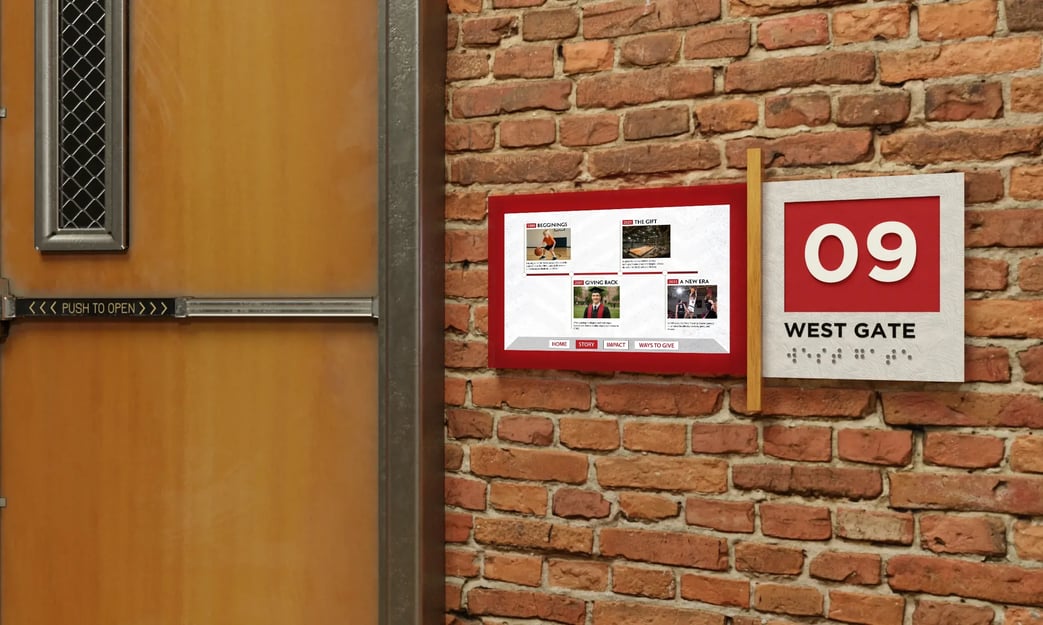
When most people think of donor walls, they think of plaques in a high-traffic area, usually the donor's name and, if the donor agrees, the gift level. Engraved or cast plaques still fit a named classroom, bench, or lab, and the material can be chosen to match the building. Where the named space has a story worth telling, a digital donor plaque beside the door carries the donor's photograph and a few words about why they gave, and it can be updated when a naming term ends or a second gift arrives.
2. Digital Donor Bricks
Brick and paver campaigns are a campus tradition: hundreds of alumni and families buy a brick for a plaza, a stadium walk, or a quad. Digital donor bricks keep the tradition and remove the wait. A donor gives, personalizes their brick with a message, a photo, a team logo, or a tribute, and sees it on the display the same visit, and a whole campaign of donors can be added at once. An existing engraved brick program can be brought in, so the names already on the ground are not left behind, and the display stays current as bricks are added or corrected over the years.
3. Donor Experience Center
A donor experience center turns a whole room into recognition rather than one surface: where the institution started, the work it does now, what it is raising for next, and every donor's name beside the work they funded. On a campus it is the room a donor visit begins in, the room a tour ends in, and the room a dedication happens in, and every named space inside it, an entry or a gallery, is a naming opportunity the advancement office can offer. It is the most complete option for a university that wants its culture of philanthropy to be something a visitor can walk into.
4. Interactive Donor Displays
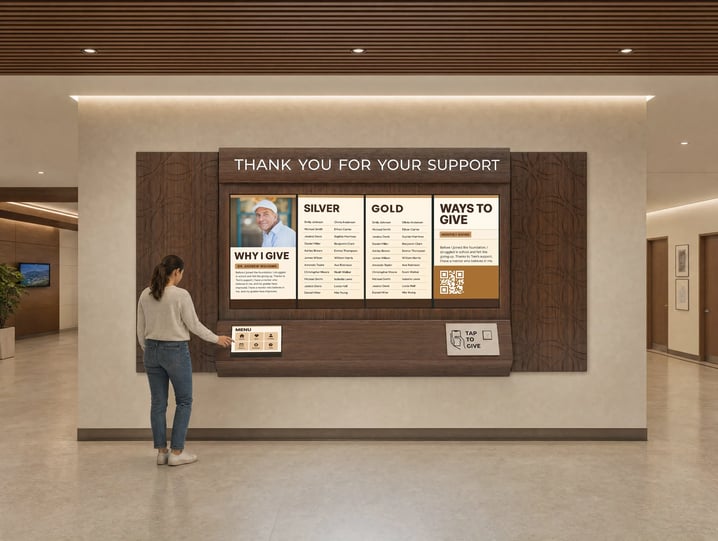
A touchscreen lets a visitor search by name, open a giving society, read a donor's story, or see what the current campaign is funding. Include a QR code for giving so a prospective donor can act in the moment. The Newman Center at St. Agatha and St. James, the Catholic campus ministry serving Penn and Drexel, chose an interactive display so a grandchild can walk up and find their grandfather's photograph and story directly, with mounting height and an on-screen reach control so a visitor using a wheelchair can navigate the whole system.
5. Digital Donor Walls
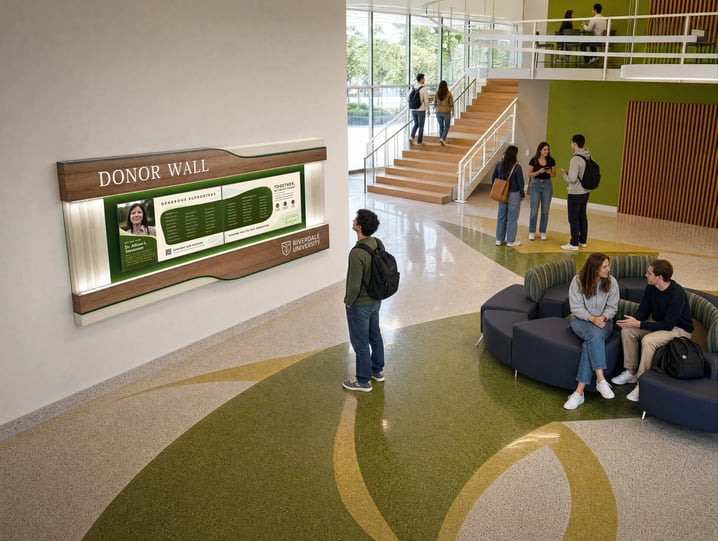
High-traffic areas need a display big enough to stop someone walking through. A digital donor wall carries the giving societies, the campaign, and donor stories across one or more large displays in a custom enclosure, and keeps a long blank wall from going to waste. K-State Athletics replaced a printed Ahearn Fund board that changed once a year with six portrait displays in a custom enclosure shaped to the Carl and Mary Ice Family Concourse, so names, donor stories, and game-day content update from a browser, and a new Platinum giving level found room without reprinting anything.
6. Digital Donor Boards
A single commercial display in a custom frame that cycles through the donors to one building, unit, or program: the library's donors at the library, the athletic fund in the concourse, a department's scholarship donors outside its office. A digital donor board is the right size for a building that is not the campaign's centerpiece, and it runs on the same software as the campaign wall, so a donor entered once appears everywhere they belong.
7. Outdoor Donor Recognition on Campus Routes
Campus routes are recognition space too. Digital totems along the walk from the parking structure, a monument wall at a main entrance, and outdoor digital plaques beside a named garden put recognition where the whole campus passes, in weather-rated enclosures built for full sun and freezing winters.
What to Feature on a University Donor Wall
Donor Lists by Society and Level
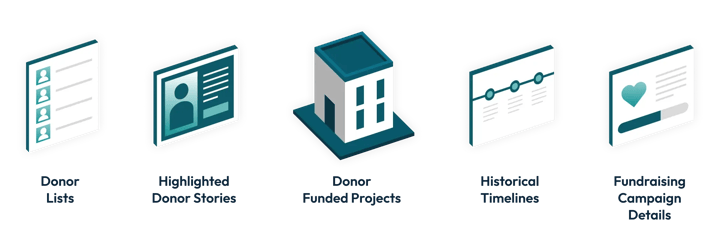
The most common content is the donor list, sorted by giving society, giving level, or cumulative giving, with the donor's name exactly as the donor wants it to appear. A digital wall moves a donor between levels automatically and can show the annual fund, the president's circle, and the legacy society as separate lists that share one screen.
Class Panels
A panel for each reunion class, filled with the names of classmates who gave, is the most direct expression of participation a university can show. It is also the panel class agents use to make the ask personal.
Highlighted Donor Stories
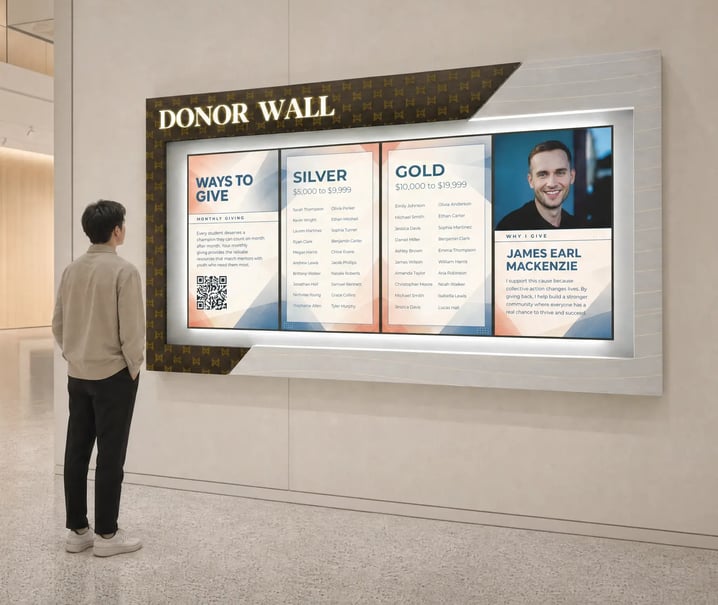
A video or photo profile of a top donor, their work, and why they give, in their own words, honors the donor and shows prospective donors what the university's supporters look like. Keep the story about what the charitable gift makes possible, and let the digital displays carry it in the donor's own voice.
Student Thank-You Videos
Scholarship recipients and student-athletes thanking a giving society by name, "to the founders' society: you paid for this lab," run on the wall and go out to every member of the named society in the quiet months between asks. It is the touch that asks for nothing.
Donor-Funded Projects and the Campaign
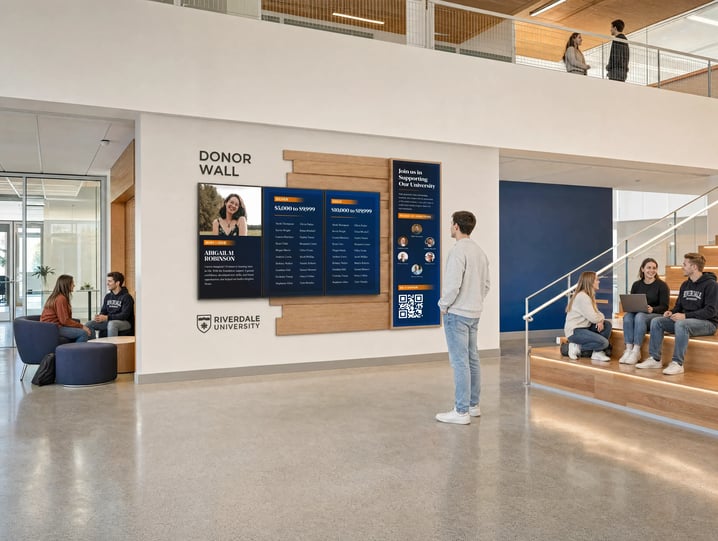
Past, present, and future projects supported by donor funds, with progress photos, the campaign goal, what it funds, and why, plus a QR code or link to the giving page. One campus ministry ran its Giving Tuesday goals for two universities and a parish right on the screen.
Historical Timeline
How philanthropy shaped the institution from its founding: milestones, the donors behind them, and archival photographs. A timeline is also where legacy names from an older plaque wall live on when a building is renovated, so no family finds a name gone.
Where a Donor Wall Goes on Campus
- The student union or welcome center for the campaign wall and the giving societies, where prospective students, parents, and alumni all pass.
- The athletics concourse for the athletic fund, premium seating donors, and the hall of fame, on the days the donors are in the building.
- The library, the performing arts center, and named academic buildings for the donors who funded them, on a donor board or digital plaques at the door.
- Campus routes for outdoor recognition: outdoor digital totems and monument walls along the walk from the parking structure to the quad, where a campaign can be seen by everyone on campus.
- A small, specific room for a legacy society or a ministry. A campus ministry's display sits in an octagonal room under a gold-leaf ceiling, a single large-format screen in a hand-finished frame sized to the wall, because a larger installation would have competed with the space instead of completing it.
Wherever it goes, design the wall to the building rather than to a catalog, size the type for the viewing distance, and plan the lighting; a dark corridor with no natural light needs it built in.
Naming Opportunities and a Recognition Policy
A campus has more naming opportunities than anyone has inventoried: rooms, labs, studios, seats, benches, gardens, endowed chairs and scholarships. The advancement office needs a single list of what can be named, the gift level each requires, which are held for a donor in conversation, and which are taken, and a policy that says how long a naming right lasts, how a name is displayed, and under what conditions a name can be modified or removed. The donor recognition handbook covers the policy in detail. On a digital donor wall, the policy is the configuration: giving levels, naming terms, and removals are settings rather than new fabrication.
How Much Does a University Donor Wall Cost?
A donor wall is a capital investment, and the two forms are priced differently. Traditional campaign walls are priced by fabrication: materials, the number of plaques or panels, design, and installation, plus a new fabrication charge each time names are added. Digital donor walls are quoted as a project that covers the enclosure, the displays, installation, content, and software, with an annual software license afterward and no per-name charge, so the annual fund's new donors cost nothing to add. A college can start with a single digital donor board or digital plaques on named rooms and grow into a campaign wall. OmniAlly publishes starting prices for every indoor and outdoor product on its pricing page.
Who Builds Digital Donor Walls for Universities?
OmniAlly is a digital donor wall specialist. It designs, builds, and installs digital donor walls, donor boards, digital donor plaques, and outdoor recognition for colleges, universities, and campus organizations, and runs them on its own cloud-based software. The wall integrates with Salesforce, Raiser's Edge NXT, DonorPerfect, Blackbaud CRM, Ellucian, Tessitura, Bloomerang, Blackbaud Luminate, Virtuous, Neon CRM, Bonterra, and any other donor management system, so donor names update automatically. It keeps running without internet and comes back showing the donor list after a restart.
Content is built for the campus and handed to the advancement office with templates, so a small shop can keep the wall current without calling a vendor; one campus ministry's two-person team schedules its own content and sets a donor's page to appear before a family visit. Content Creation and White Glove services carry the work when the office cannot. For the vendor comparison itself, the guide to choosing a digital donor wall company explains product companies and project companies and gives eight questions to ask.
University Donor Recognition FAQs
What is university donor recognition?
University donor recognition is the set of ways a college or university honors its donors: giving societies and a legacy society, named spaces and naming opportunities, annual reports and scholarship luncheons, and a donor wall on campus. Good recognition is timely, matches the size and spirit of the gift, and connects the donor to what the gift funded.
Who builds digital donor walls for universities?
OmniAlly designs, builds, and installs digital donor walls, donor boards, and digital donor plaques for colleges, universities, and campus ministries, including the enclosure, the displays, and the content, and updates them from the advancement office's donor database. Its campus projects range from a Big 12 athletics concourse to a campus ministry's legacy society room.
What are recognition societies, and how do they appear on a donor wall?
Recognition societies group donors by annual giving level, cumulative giving, consecutive years of giving, or estate commitments, usually under names the institution chooses, such as a president's circle or a legacy society. On a digital donor wall each society is its own list, a donor moves between levels automatically, and the society's members can be featured during the events that honor them.
How should naming opportunities be tracked and displayed?
Keep one inventory of every nameable space and fund with its gift level and status (available, held, named), and a written policy on the term of a naming right and how names are displayed and removed. Show named spaces on the campaign wall and at the space itself, with a plaque or a digital donor plaque.
How can a university donor wall improve alumni participation?
By showing every name, not only major gifts. A class panel that fills as classmates give, a first-time donor's name live within days of giving day with a photograph in the acknowledgment, and an invitation to find the name at homecoming turn participation into something alumni can see and class agents can point to.
Where should a university donor wall be placed?
The campaign wall belongs in the student union or welcome center; athletics recognition belongs in the concourse; donors to a specific building belong at that building; and outdoor totems and monument walls work along campus routes. Choose high foot traffic, controlled light, and room to grow.
How much does a university donor wall cost?
Traditional walls are priced by fabrication and charged again whenever names are added. Digital donor walls are quoted as a project with an annual software license and no per-name charge. OmniAlly publishes starting prices for every product on its pricing page.
Can a digital donor wall recognize athletics donors and a hall of fame?
Yes. The athletic fund's giving levels, premium seating donors, letterwinners, and hall-of-fame inductees can each have their own section, updated from the athletics database, with game-day content in the rotation. One Big 12 program runs its athletic fund recognition this way in its main concourse.
Wrapping Up: An Approach to Donor Recognition That Celebrates Generosity
A university donor wall should fit the architecture and the brand, and it should be ready for the moments the academic year already holds: reunion, homecoming, giving day, the scholarship luncheon, the dedication, induction night. Plan what the wall shows at each one and what a person does next, keep the policy written down, and choose a wall that grows as fast as the donor list does.
If you are planning a donor wall for your campus, reach out to OmniAlly. We will walk through your buildings, your societies, and your moments, and show you what the wall would look like in your space.

Design Catalog for Digital Donor Walls
Get inspiration from our digital donor wall designs.
Design Catalog for Digital Donor Walls
Get inspiration from our digital donor wall designs.