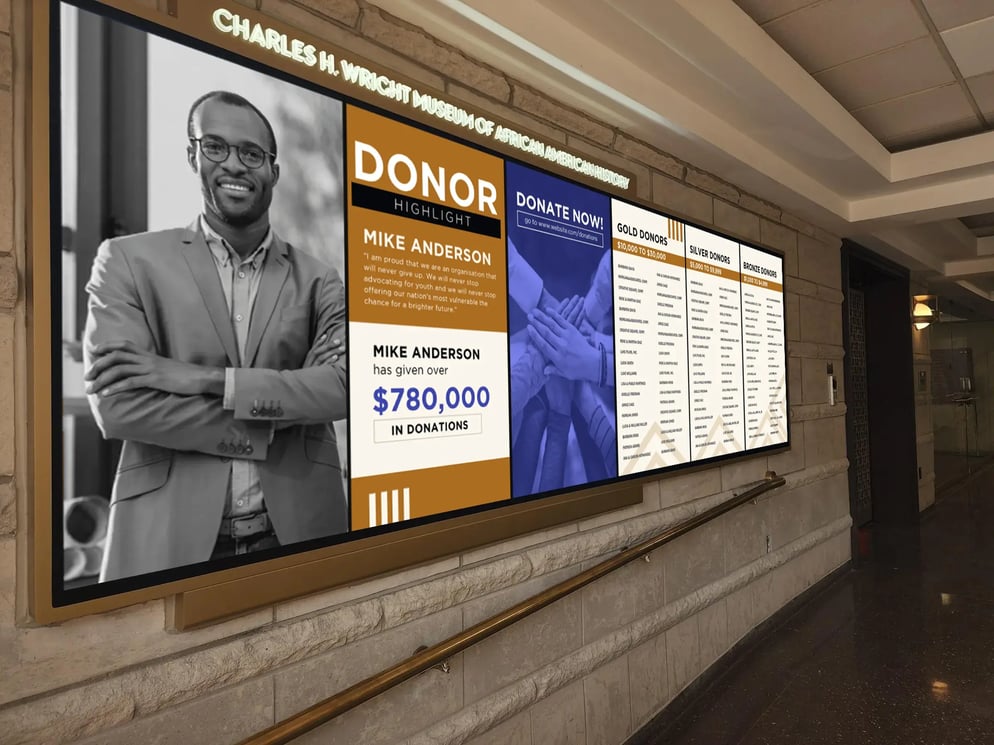
For nonprofits, showing appreciation for donors in public is not optional. It feeds donor retention and the next ask. Most development offices know that. What gets overlooked is how an audience sees the recognition: whether every donor can read it, whether it changes when a gift lands, and whether it says anything beyond a list of names.
For nonprofits, showing appreciation for donors in public is not optional. It feeds donor retention and the next ask. Most development offices know that. What gets overlooked is how an audience sees the recognition: whether every donor can read it, whether it changes when a gift lands, and whether it says anything beyond a list of names.
A digital donor recognition wall is one or more commercial digital displays, built into a wall or an enclosure, that show donor names, giving levels, and stories from software your development office controls. Over the past few years, digital donor recognition walls have gained ground over engraved walls because they do more than recognize donors. This article covers how digital recognition compares with the traditional wall, what digital donor boards and plaques are for, the benefits of digital donor walls for stewardship and fundraising, and then how to choose a digital donor wall company.
Digital Recognition vs. the Traditional Wall: Engraved Walls and Traditional Plaques
For decades traditional donor recognition meant one thing, a traditional wall with names cut into glass, cast in bronze, or printed on traditional plaques, sometimes arranged as a donor tree. A physical donor wall like that keeps one promise, that what was given here will not be forgotten, and it keeps it well. What it cannot do is change. To add a name you etch or engrave a new plaque, or wait for the next fabrication run, so the wall records a finished campaign rather than taking part in the next one.
Digital donor walls run on media players or small computers behind commercial displays, fed by cloud-based software. Names, giving tiers, photos, video, and campaign updates change from a dashboard, and the same digital system can drive one screen or a whole set of interactive displays. Here is where the two approaches differ in practice.

Legibility
Have you ever stood in front of a traditional donor wall and struggled to make out the names? Even a beautiful gold or silver plaque is hard to read from across a lobby. Digital donor walls do not have this problem. You choose the type size and style, and with a high-contrast color scheme every donor's name is legible from the far side of the room.

Adaptability
Add a new donor, correct a spelling, move a donor to a new giving tier: on a digital wall it happens from a dashboard the same day. On static plaques the same change means new fabrication, a lead time of weeks, and an invoice. That gap is the difference between a wall that records recognition and a recognition program that keeps up with the gifts.
Effectiveness
Donors want to feel celebrated, and an effective donor recognition wall matches the weight of the gift. When donors see bold public recognition, with the stories beside their names, donors give again, which shows up as higher retention and an increase of their gift size.

Digital donor walls also let you create engaging content for the moment at hand. Hosting a 1920s-themed gala? Dress the wall for the night. Launching a capital campaign? Put the case for support on the screen the week it opens. A traditional wall looks the same at every event.
Design Catalog for Digital Donor Walls
Get inspiration from our digital donor wall designs.
Stories and Multimedia
Digital walls are also video walls. They can play impact stories, a video of a donor explaining why she gives, or a caregiver describing what a grateful patient's gift lets her do, as multimedia rather than a caption. Add a QR code that leads directly to a donation page and the wall becomes a way for donors to give on the spot, at the moment the story lands.

If your organization sells tickets, memberships, or goods, the same QR code can lead there. A traditional donor wall serves one purpose, displaying names. A digital one can show your appreciation and open the next conversation at the same time.
Remote Access and Donor Database Sync
A digital donor wall is managed from anywhere, on a computer, phone, or tablet. Add or remove a name, correct a typo, or post a campaign update without touching the hardware. Purpose-built donor wall software goes further than a general digital signage platform: it can support automated updates from Salesforce, Raiser's Edge NXT, DonorPerfect, Blackbaud CRM, Ellucian, Tessitura, Bloomerang, Blackbaud Luminate, Virtuous, Neon CRM, Bonterra, and any other donor management system, so the names on the screen match the names in your records. A well-built wall also keeps playing when the building's internet drops.
Cost and Lead Time
A traditional donor wall can look cheaper on the first quote. The comparison changes once you count what each wall does afterward. Digital donor recognition walls work on the numbers that matter, donor retention, average gift size, and new donors, by letting you engage donors in public with Why I Give stories, donor highlights, impact stories, how-to-give information, and campaign updates, all without a fabrication lead time. When has a traditional donor wall ever paid for itself? A digital donor wall can.

Digital Wall, Donor Board, or Digital Plaque: Which Fits the Space
Not every space needs a full wall. A digital donor board is a single commercial display that cycles through names, donor levels, and campaign updates, which makes it the right fit for a hallway, a clinic lobby, or an athletics facility where one screen carries the recognition program for that building.
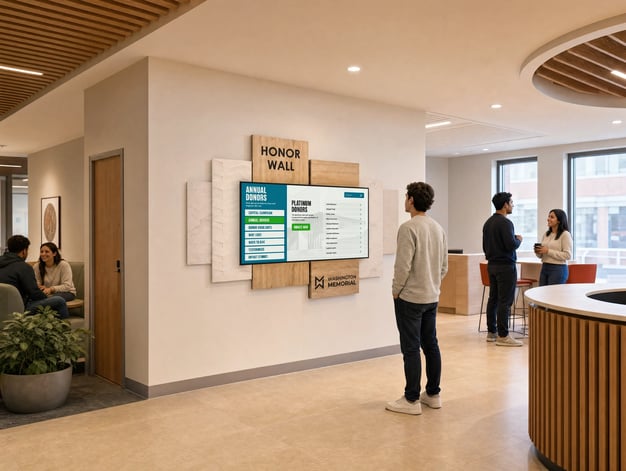
A digital donor recognition plaque is smaller still and sits beside a named room or space. Because it holds less content, a plaque can tell a story in one frame: who made this room possible, with a photo and a short story, and it can show major donors, board members, or valued volunteers in turn. Digital walls carry the breadth of names and stories; digital plaques put a single story where the gift lives. Organizations often run more than one, and the same cloud-based software drives the wall, the board, and the plaque as one digital solution: a single recognition display or a whole set of donor recognition displays.
Benefits of Digital Donor Walls for Stewardship, Fundraising, and Your Recognition Program
Recognition is stewardship made visible. Here is how digital donor walls create return beyond the names themselves.
Donor Highlights and Why I Give Stories
Storytelling moves people to give, and a donor explaining in her own words why she gives is the strongest story you have. Because a digital wall is also a video wall, a 60-second Why I Give clip is easy to run, and donor preferences decide how it appears: some donors want a photo and a line, some want the full interview.

Donors appreciate seeing the recognition. Prospective donors see the pride your donors take in you, which is the start of a donor relationship of their own. On an interactive touchscreen, visitors can search by name, open a giving society, or browse the stories at their own pace, which is what interactive recognition displays add. On a wall without touch, the stories rotate on their own for the people walking by.
Impact Stories and Campaign Updates
Digital donor walls do more than recognize donors; they fundraise. Beside the Why I Give stories, add impact stories told by the people a gift reached. During a campaign, give it a panel of its own: the goal, the progress, what the money builds, and a QR code to the giving page, so the people who see the wall that week can give before they leave the building.

Planned this way, a digital donor wall takes work off the donor relations team instead of adding to it: the wall shows what the year already contains, and a person sends the photograph.
How to Choose a Digital Donor Wall Company
Donor recognition wall companies that sell digital walls are either product companies or project companies. A product company sells software, with or without a touchscreen, that your organization sets up and runs. A project company designs, builds, and installs a donor wall for your space. Within the project companies there is a further split, between fabrication shops that are willing to add screens and digital specialists such as OmniAlly, whose business is the digital wall itself. They are priced differently, they get donor names onto the screen differently, and they leave different amounts of work with your staff. Here is how to tell them apart, and eight questions to ask any of them.
Product companies and project companies
Product companies. A product company sells software that puts donor recognition on a screen. Some sell general digital signage software, where donor recognition is one template among many. Some sell software made for donor recognition. Some bundle a standard kiosk or wall-mounted touchscreen with it. Either way, it is a product you set up and run. You pay per display per month or year, or an annual software fee plus hardware, and donor names come in by manual entry, a spreadsheet upload, or a Google Sheet.
The price covers the software and the basic hardware. Everything else moves onto your staff: project management, graphic design, the enclosure or hardscape and how the display is built into it, power and network, ADA mounting height and reach, ventilation and heat, keeping the spreadsheet current, and making the wall perform as recognition rather than as a slideshow, inside the templates the product allows.
A product fits when you have one display to fill, a team that can own those jobs, and recognition needs a template covers. How to tell: the proposal is priced per display or per license, lists hardware models, and contains no drawings of your space.
Project companies. A project company designs the wall for a specific space and brand, fabricates the enclosure, installs the displays, and delivers the software that runs them. The project is quoted, not subscribed to, and the wall becomes part of the building. This is the right group when the donor wall has a job to do in your fundraising year: when a gift lands and the name should be up that week, when a tour ends in front of it, when the next capital campaign launches in the room, when a building is dedicated, and when a family comes back on the date they remember. Which project company is right depends on what the firm is built around.
Three kinds of project companies
Traditional-only fabricators. These shops make engraved, printed, and cast recognition: walls, plaques, bricks, and monuments. Many do beautiful work, and the wall costs nothing in software. What it fixes in place is not only the names but the moment. Donor recognition is an ongoing stewardship strategy: a new gift goes up the week it lands, a gift anniversary is marked, a campaign launches in front of the names that funded the last one, a donor's own story plays beside the project it built. That is how recognition keeps feeding a culture of philanthropy instead of commemorating one. An engraved wall can do none of it without new fabrication, so choose one only if you have decided recognition will be a monument to a finished campaign rather than part of your fundraising from here on.
Fabricators that are willing to add digital. These are traditional shops that are willing to add screens. Some have even built their own donor wall software. What they lead with has not changed: the traditional wall is the first proposal, and digital is what they reach for when a client asks for it or wants a big experience on a smaller budget. The shop's revenue is in the hardscape, and day-to-day training and software support are commonly handed off to the hardware and software makers. "Offers digital" is not the same as "specializes in it." This is a good choice when the wall is mostly traditional with a small digital element inside it, when you are adding a screen to a traditional wall the shop already built for you, or when the reveal is the only moment that matters and the content will rarely change afterward. How to tell: look at what the first proposal leads with, ask what changes when you say you want it digital, and ask who trains your staff and takes the support call in year two.
Digital specialists. A digital donor wall specialist is a project company whose business is the digital wall itself: the display, the software, the content, the donor data, and the enclosure that holds them. The enclosure is engineered to serve the screen, with sightlines, ADA height and reach, glare, ventilation, and service access worked out before fabrication.
What sets a specialist apart is that it builds moments, not just a wall. A traditional wall keeps one promise: what was given here will not be forgotten. A digital wall can make new ones, because it can change quickly, cost effectively, and on a schedule. A specialist starts from the occasions your year already has and plans what the wall does at each one. When a gift lands, the name is up that week, and the family gets a photograph while the gesture still means everything. When a major donor arrives with guests, the giving society their mother belonged to is front and center. When a tour ends in the room, the case for the next campaign is already playing. When a building is dedicated, the donors who funded it see their names beside the work. On a gift anniversary, a name comes back on its date. At year-end, the campaign's finish line runs on the wall.
Stories are how those moments carry weight: a Why I Give story in a donor's own words, an impact story told through the people a gift reached, a caregiver's story of what a grateful patient's gift lets her do, a then-and-now story on the day the doors open. A specialist matches the story to the weight of the moment, so a six-figure gift and a first gift are each honored at the right scale, and it helps you keep the stories coming all year.
Everything else a specialist does serves that. It can connect to your donor database by name when you want the wall to update itself, and it makes the manual path just as easy, since many development offices prefer to put eyes on every name before it goes up. It runs its own software and its own support. It keeps the wall running without internet. It publishes its prices. It offers content services so the wall never goes stale. And it can show walls still working years after installation. How to tell: the proposal starts with your moments and the stories, then the enclosure, a donor database connection is offered rather than assumed, and the firm answers software questions itself.
OmniAlly is a digital donor wall specialist. It designs, builds, and installs digital donor walls, donor boards, digital donor plaques, and donor experience centers, indoors and outdoors, and runs them on its own cloud-based software, with automatic updates from Salesforce, Raiser's Edge NXT, DonorPerfect, Blackbaud CRM, Ellucian, Tessitura, Bloomerang, Blackbaud Luminate, Virtuous, Neon CRM, and Bonterra. Its walls keep running without internet, its starting prices are published for every product, and its Content Creation and White Glove services keep the stories and the names current.
Eight questions to ask any digital donor wall company
- How do donor names get onto the wall? Manual entry, a spreadsheet upload, a Google Sheet, or a direct connection to your donor database. Ask which systems are supported by name and how the update runs. OmniAlly integrates with Salesforce, Raiser's Edge NXT, DonorPerfect, Blackbaud CRM, Ellucian, Tessitura, Bloomerang, Blackbaud Luminate, Virtuous, Neon CRM, Bonterra, and any other donor management system, so donor names update automatically.
- What exactly are you buying? A software subscription, a kiosk bundle, a design-build project, or a fabricated wall. If it is a project, you can tell what the company is built around without asking: look at what the first proposal leads with, look at whether the portfolio is mostly engraved and cast walls or mostly working screens, ask who wrote the software that runs the wall, and ask who answers the support call in year two. A fabrication-first firm leads with the hardscape and hands software questions to a partner. A digital specialist leads with what the wall will do and answers the software questions itself. That decides who designs the wall, who owns the hardware, who runs the software after installation, and what happens when a screen fails in year four.
- What work stays with our staff? With a product, your team owns project management, graphic design, the enclosure, compliance, and upkeep. With a project, ask exactly which of those the vendor takes on and which it hands back.
- How is it priced, and what does the whole solution cost? A product is priced per display per month or per license, and that number covers the software and basic hardware. The rest of the project, from design and enclosure to installation and content, is left for you to source and manage, so no product vendor can quote the whole solution. You find out what it cost after you have built it and counted the internal hours. A project is quoted as a whole. To compare the two fairly, add up everything the product path will take, including your staff's time, and set it against what a specialist would deliver for the same money.
- What happens when the internet drops? Lobbies lose Wi-Fi. Ask whether the wall keeps playing from local storage or goes dark, and ask what happens if the power blinks and the system restarts while the internet is still down: does it come back showing the donor list, or a black screen? OmniAlly walls keep running without internet and come back showing the donor list after a restart.
- Does it need a touchscreen? Not always, and a vendor whose product is a touchscreen will usually propose one. A wall that rotates names and stories on its own serves the people walking past it, and it has no surface to wipe down, which matters in a hospital. If you do not have thousands of names that each deserve a deep dive, the money a touchscreen costs can go into a larger display or better materials in the hardscape. Touch earns its place when visitors should search by name through a searchable donor list, tap a name to open a bio with photos, browse a photo gallery, or look through giving tiers, awards, and giving societies. When it does, the mounting height and reach have to work for a visitor in a wheelchair, which is an ADA requirement rather than a design preference.
- What does the donor wall do to improve the donor experience? A company that builds experiences will ask about the occasions you already share with donors, the gift acknowledgment, the site visit, the tour, the campaign launch, the dedication, the anniversary, and tell you what the wall can do at each one to create a moment. If the vendor never asks about those occasions, it is selling parts, not building an experience.
- What proof is there? Ask for customer references in your sector, case studies with named organizations, and walls still running years after installation.
Product or project: what to expect
| Product company | Digital specialist (OmniAlly) | |
|---|---|---|
| What you buy | Software, plus standard screens or kiosks you buy or supply | A wall designed for your space: enclosure, displays, installation, content, and cloud software, indoors or outdoors |
| Your staff's work during the project | Project management, graphic design, enclosure and hardscape design, power and network, ADA mounting and ventilation, installation | Approving the design and the content plan, and sharing your brand assets and donor list |
| Your staff's work after installation | Keeping the spreadsheet current, building the content, and fixing what breaks | Sending new gifts and stories as they happen; with White Glove, OmniAlly's team handles every update so your staff never has to log in |
| How donor names get in | Manual entry, spreadsheet upload, or a Google Sheet | Dashboard entry or a file upload, with eyes on every name, or automatic updates from Salesforce, Raiser's Edge NXT, DonorPerfect, and any other donor management system |
| What the wall does at your moments | Whatever your staff builds into the template | Planned for each occasion: the gift that lands, the visit, the tour, the campaign launch, the dedication, the anniversary, with stories matched to the weight of the moment |
| Pricing | Per display per month or year, or an annual fee plus hardware; the rest of the project is sourced and paid for separately | One project quote for the whole solution, plus an annual software license; OmniAlly publishes starting prices for every product |
| Who installs and supports | Your team or a local installer; support from the software maker | OmniAlly handles on-site installation and supports its own software |
| When the internet drops | Depends on the product; ask before you buy | OmniAlly walls keep running without internet and come back showing the donor list after a restart |
| Best fit | One display, a team that can own the design and the build, and needs a template covers | Hospitals, universities, schools, arts organizations, senior living, and faith communities that want recognition to keep working after the unveiling: new gifts up that week, donors coming back, and the next campaign launching in front of the names that funded the last one |
Which is right for your organization
Among donor recognition wall companies, the right choice depends on the job you need the wall to do:
- One display, a team that can design, build, and maintain it, and needs a template covers: a product company. Count the staff hours as part of the price.
- A wall built for your space and installed by the vendor: a project company. Then choose which kind:
- A monument to a finished campaign, with no plan to keep recognition working in your fundraising: a traditional-only fabricator, with eyes open to what that gives up.
- A mostly traditional wall with a small digital element, or a screen added to a traditional wall the shop already built for you: a fabricator that is willing to add digital. Ask who trains your staff and who takes the support call before you sign.
- A wall that takes part in your fundraising year, moment by moment, and stays current from your donor database: a digital specialist.
OmniAlly is a digital donor wall specialist. Customers include Baptist Health, K-State Athletics, Colorado Northwestern Community College, the Marcus Jewish Community Center of Atlanta, and Fresh Start Women's Foundation. Digital donor wall examples from each are in the case studies, and starting prices for every product are on the pricing page.
Digital Donor Recognition Walls FAQs
What is a digital donor recognition wall?
A digital donor recognition wall, also called a digital donor wall or an electronic donor wall, is a screen-based donor wall that shows donor names alongside impact stories, campaigns, photos, and video. Unlike an engraved wall, the names and content are updated from software, so new donors appear in minutes and the wall keeps telling the story of what giving makes possible.
What are the benefits of a digital donor recognition wall over a traditional donor wall?
A digital donor recognition wall is more engaging and, over time, more cost-effective than a traditional engraved wall. It uses photos, videos, and animation to hold attention, and names, giving levels, and stories are updated instantly through the software, without the reprinting and reinstallation costs a traditional donor wall requires every time a name changes.
What is the difference between a virtual donor wall and a digital donor recognition wall?
A digital donor recognition wall is a physical, screen-based display installed in your building. A virtual donor wall lives online, usually on your website. Both are effective, but they reach different audiences: a digital wall engages visitors, staff, and the people you serve on site, while a virtual donor wall lets remote and out-of-town supporters see their recognition from anywhere. OmniAlly offers both, and a virtual donor wall can mirror the content of your physical wall.
How do you display different giving levels on a digital donor wall?
A digital donor wall gives you flexibility a static wall does not. Common approaches include dedicated colors or digital badges for each giving society, grouping donors by campaign, lifetime giving, or consecutive years of support, rotating premium placement so top-tier supporters are featured during high-traffic events, and giving major donors their own screen time with a photo and a Why I Give story.
Does a digital donor recognition wall need to be touchscreen?
No. A digital donor wall can rotate through donor names, giving levels, impact stories, and campaigns on its own for people walking by. Touchscreen interaction is optional. It is worth adding when you want visitors to explore giving societies, donor stories, or campaign content for themselves, and it should be mounted at a height seated visitors can reach.
Can a digital donor recognition wall sync with Raiser's Edge, Salesforce, or another donor database?
Yes. OmniAlly's digital donor walls update donor lists automatically from Salesforce, Raiser's Edge NXT, DonorPerfect, Blackbaud CRM, Ellucian, Tessitura, Bloomerang, Blackbaud Luminate, Virtuous, Neon CRM, Bonterra, and any other donor management system. Beyond that, maintenance is light: OmniAlly handles hardware installation and software setup, and your team manages names and content from a cloud dashboard.
How much does a digital donor recognition wall cost?
The cost depends on the number and size of displays, the materials and enclosure, the design, and installation, plus an annual software license. OmniAlly publishes starting prices for every indoor and outdoor product on its pricing page, so you can compare a single-screen donor board, a multi-screen donor wall, digital donor plaques, and a full donor experience center before you talk to anyone.
How can we make a digital donor wall accessible to visitors with disabilities?
Use ADA-minded design from the start: large, high-contrast text, adjustable text sizes and high-contrast modes on interactive screens, screen-reader compatibility for kiosks, and captions on every video. OmniAlly mounts touchscreen panels at wheelchair-accessible heights and includes closed captions on video content.
What is the best digital donor wall company?
There is no single best digital donor wall company, because the vendors sell different things. Product companies sell signage software and touchscreen kiosks at the lowest price for software and basic hardware, and your staff takes on the project management, graphic design, enclosure, compliance, and upkeep. Project companies deliver the wall as a design-build project, and among them a digital donor wall specialist such as OmniAlly builds moments, not just a wall: a new gift up the week it lands, the next campaign playing when a tour ends, a name back on its anniversary, with Why I Give and impact stories matched to the weight of each moment, all kept current from your donor database. The best choice depends on whether you want a product or a project, how much work your staff can own, and whether the wall should take part in your fundraising year.
Which digital donor wall companies integrate with Raiser's Edge NXT, Salesforce, or DonorPerfect?
Ask any vendor to name the systems it supports and how the update runs. OmniAlly integrates with Salesforce, Raiser's Edge NXT, DonorPerfect, Blackbaud CRM, Ellucian, Tessitura, Bloomerang, Blackbaud Luminate, Virtuous, Neon CRM, Bonterra, and any other donor management system, so donor names update automatically. Many products load names by manual entry, a spreadsheet upload, or a Google Sheet, and some vendors say they integrate without naming a system, so ask which it is.
What is the difference between a donor wall fabricator that offers digital and a digital donor wall specialist?
A fabricator that offers digital is a traditional shop that is willing to add screens, and some have built their own donor wall software. It leads with the traditional wall and reaches for digital when a client asks for it or wants a big experience on a smaller budget. It earns on the hardscape, so training and software support are often handed off to the hardware and software makers. It is a good choice when the wall is mostly traditional with a small digital element inside it, or when you are adding a screen to a traditional wall the shop already built. A digital donor wall specialist such as OmniAlly builds moments, not just a wall: the name up the week a gift lands, the right giving society front and center when a donor visits, the next campaign playing when a tour ends, a name back on its anniversary, with Why I Give and impact stories matched to the weight of each moment. It can connect to your donor database by name when you want that, runs its own software and support, and designs the enclosure to serve the screen. The practical tests: what the first proposal leads with, what changes when you ask for digital, and who trains your staff and takes the support call in year two.
Who installs a digital donor wall?
Product companies usually ship hardware for your team or a local installer to mount. Project companies, including OmniAlly, handle on-site installation themselves. OmniAlly also supports its own software after installation.
Conclusion: Donor Recognition Displays That Keep Working
Dynamic digital walls are replacing traditional walls because they do more than hold names in place. They stay legible, change the day a gift lands, carry the stories that move donors to give again, and connect to the donor database the development office already runs.
An interactive donor wall, a donor board, or a digital plaque changes how you recognize donors, and it also changes how you fundraise and share the impact of the work. The remaining question is who should build it, which is what the section on choosing a digital donor wall company above is for.
Upgrade your donor experience by reaching out to OmniAlly and booking a demo.
Design Catalog for Digital Donor Walls
Get inspiration from our digital donor wall designs.
Design Catalog for Digital Donor Walls
Get inspiration from our digital donor wall designs.