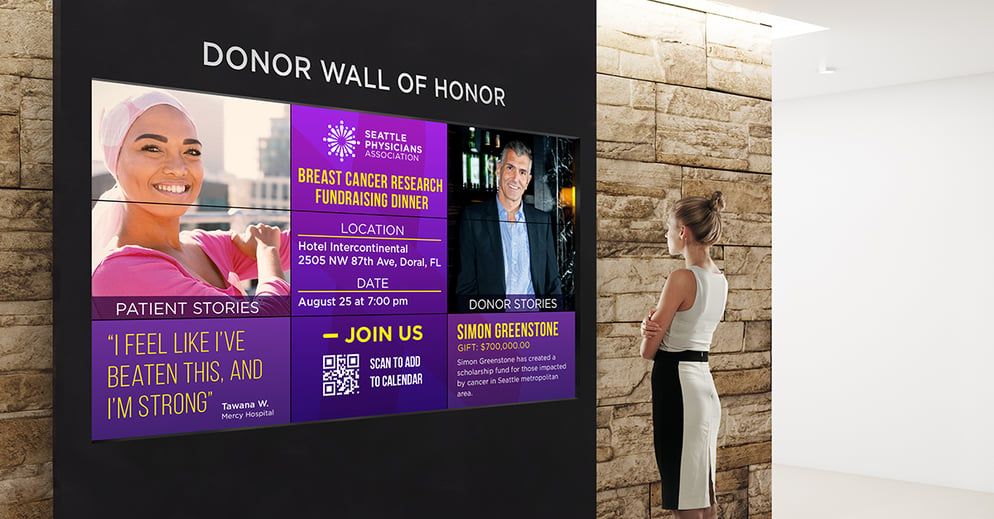
Philanthropy events are the fundraising events a nonprofit hosts to raise money and bring its community together around a cause: the gala, the golf tournament, the charity auction, the walkathon, giving day, and the signature event the whole year builds toward. They are also the one night a year most of your donors are in the same room, which makes them the best recognition opportunity on the calendar. OmniAlly builds digital donor walls that run live at fundraising events, with the campaign thermometer climbing on screen, sponsor logos rotating by event, and the names of the night's donors shown before the room empties.
Philanthropy events are the fundraising events a nonprofit hosts to raise money and bring its community together around a cause: the gala, the golf tournament, the charity auction, the walkathon, giving day, and the signature event the whole year builds toward. They are also the one night a year most of your donors are in the same room, which makes them the best recognition opportunity on the calendar. OmniAlly builds digital donor walls that run live at fundraising events, with the campaign thermometer climbing on screen, sponsor logos rotating by event, and the names of the night's donors shown before the room empties.
A signature event is the flagship recurring gathering on a nonprofit's calendar, the one night or day each year when the whole community assembles and most of the year's event fundraising happens; every format below can be one. This guide is about what a digital recognition system does at each kind of event, not how to run the event, because nonprofit fundraising events are the moments when recognition has the largest audience it will get all year. It takes nine philanthropy event ideas and answers the same questions for each: what the wall shows on the night, where the gift data comes from, what a person does afterward, and what that produces a year later. It closes with how the wall connects to your event platform and donor database, and what to put on it.
What a Digital Donor Wall Does at a Fundraising Event
A fundraising event has three jobs: raise money, deepen the relationship with the people who came, and make the case to the people in the room who have not given yet. A digital donor wall works on all three at once. During the program it is the live scoreboard: the campaign thermometer, the paddle-raise total, the auction leaderboard, the matching challenge. Between program segments it is the sponsor recognition, rotating logos by tier so every sponsor is seen more than once. And as gifts are entered, it is the donor wall: the names of the people who gave tonight, up before the room empties, beside the names of the people who gave last year.
The gifts come from the event platform or the donor database, so nobody retypes a name on the night. After the event, the same wall carries the campaign and the donor list for the year, and the photograph of a donor's name on it is what the thank-you email leads with. That photograph, and the invitation to come see the wall, is what turns a night's gross into a second gift.
9 Fundraising Event Ideas and What the Recognition System Does at Each
1. The Charity Gala
The gala is the signature event for organizations with major donors and corporate sponsors: a produced program, a paddle raise, usually a live auction, and the year's biggest concentration of the people who fund the mission. Sponsors underwrite the live entertainment and the VIP tables, and its recognition problem is scale. Sponsors at four tiers, a hundred paddle-raise gifts in twelve minutes, and last year's donors in the room all need to be seen, and a slide deck cannot keep up.
On the wall: the campaign thermometer climbs as the paddle raise runs, with the lead gifts at each level named as they land; sponsor logos rotate by tier through the reception and dinner; the names of the night's donors are on screen before the room empties, beside the campaign's existing donors. Afterward: every donor's thank-you carries a photograph of their name on the wall, and the sponsor recap shows the rotation their logo got on the night and the month it stayed up. Fresh Start Women's Foundation hosts frequent events in its own building, and its lobby donor wall doubles as the storytelling piece for guests, showing who stands behind the mission and why.
2. The Silent Auction, Live Auction, or Online Auction
Whether the auction is silent with mobile bidding, live with an auctioneer, or online so supporters can browse and bid for a week before the event, its recognition problem is that the winning bidders are the night's most engaged donors and they are usually thanked with a receipt. Donated items carry the margin, and the lots that cost nothing to procure, naming rights to a room, lunch with the executive director, a reserved parking spot, are recognition in themselves, and they deserve to be shown.
On the wall: a live leaderboard of lots with bids, the winning bidders recognized on screen as each lot closes, and the naming-rights buyer's new room shown with their name before they leave the building. The guests who bought raffle tickets at the door and the general admission crowd who did not bid see the same screen, which is the case for next year. Afterward: the winning bidders are featured on the wall for the month, and the naming-rights gift becomes a digital donor plaque at the room itself.

3. The Culinary Experience, Wine Tasting, and Bake Sales
Culinary events, from a chef's table or a regional dinner to a wine tasting underwritten by a partner winery, are cultivation events for mid-level donors in an intimate setting, built around unique experiences a ballroom cannot offer. Bake sales and cake walks sit at the community end of the same spectrum. The recognition problem is that the partners who made the evening possible, the chef, the winery, the host, are sponsors and are rarely treated as such, and that the gifts made at the table tend to arrive by follow-up email instead of in the room.
On the wall: the partners' recognition in the sponsor rotation, the campaign the ticket price supports, and a QR code to the giving page beside it, so a guest gives for the good cause while the plates are still out and the gift lands in the campaign that night. Afterward: the evening's donors join the campaign list, and the partner winery gets the same recap a gala sponsor would.

4. The Golf Tournament Fundraiser
A golf outing is a corporate relationship event: revenue comes from foursome and hole sponsorships sold to local businesses, with a closest-to-the-pin contest for friendly competition, and the whole day is a sponsor recognition exercise that usually ends with a banner and a sign on a tee box. The recognition problem is that the sponsors leave with nothing that lasts past the awards dinner.
On the wall in the clubhouse: the sponsors by hole and by package, the leaderboard, and the awards, and a photograph of each sponsor's foursome beside their logo on the wall taken during the awards. Afterward: that photograph goes out with the thank-you the next morning, the logos stay up in the lobby for the month, and the ten-months-later renewal ask opens with last year's recognition instead of a blank slate.


The Advantages of Digital over Traditional Donor Walls
Learn the top reasons nonprofits are moving away from traditional donor walls and embracing the flexibility digital offers.
5. Peer-to-Peer Fundraising
Peer-to-peer fundraising is an acquisition engine: supporters raise money from their own networks, and most of the resulting donors have never heard of the organization before a friend asked. The fundraising platform supplies the fundraising pages and the email templates. What it does not supply is a reason for a friend-of-a-friend donor to give a second time, or any recognition for the ambassadors who did the work.
On the wall: the top fundraisers and the running total through the campaign window, updated from the platform, so the office lobby shows the campaign the way the leaderboard online does; the peer-to-peer champions recognized by name at the finish, which is the moment they decide whether to do it again. Afterward: every new donor's name goes up within days, and the acknowledgment carries the photograph and an invitation to come see it, which is the first step from a one-time record to a donor.
6. Walkathons, Runs, and Rides
Walkathons, charity runs, and rides reach the broadest base of any format: an entry fee, per-mile pledges, team pages, sponsors on the water stations, public parks or campus routes that keep venue costs low, and the volunteers you recruit for registration and the finish line. It is as much a community event as a fundraiser. The recognition problem is volume: hundreds of participants, dozens of teams, and sponsors who get a logo on a shirt.
On the wall at the finish line, or in the lobby the route ends in: the teams, the totals, the sponsors, and the day's donors up before they leave. Afterward: the team captains are featured for the month, and the sponsors' recap includes the morning's rotation.
7. Giving Day
A giving day concentrates a year of online giving into twenty-four hours and builds community around a cause without a venue. GivingTuesday is the biggest: the GivingTuesday Data Commons estimates that 38.1 million people took part in GivingTuesday 2025 and gave $4.0 billion in the United States, 13 percent more than the year before, and Gravyty's 2026 guide calls the institutional giving-day cycle the most competitive yet. The recognition problem is that a giving day happens on a landing page, invisible inside the organization's own building, and that the giving-day donor is the donor most likely never to give again.
On the wall: the goal and the running total on screen in the lobby all day, fed from the giving platform; the matching challenge announced on the wall when it opens and marked when it is met; and every first-time donor's name live within days, which is where the second gift begins. The Newman Center serving Penn and Drexel ran its Giving Tuesday goals for two universities and a parish right on its donor display. Afterward: the giving-day class is the group the ninety-day follow-up is built around: photograph, invitation, visit.

8. The Pledge Drive and the Year-End Campaign
Public media stations, faith communities, and annual funds raise a large share of the year in a pledge drive or a year-end campaign window with a goal, a deadline, and a matching challenge. The recognition problem is that the campaign lives in email and on air while the people walking through the building see nothing.
On the wall: the thermometer, the match, the names of this week's donors, and the finish line when the goal is met; when the window closes, the total, the number of donors, and what the money builds, so the people who gave see the finish and the people who did not see what they missed. Afterward: the campaign's donors stay on the wall as the campaign's panel until the next one opens.
9. The Virtual Gala or Hybrid In-Person Event
Virtual fundraising and hybrid events open the room to supporters who cannot travel: a produced program on live streaming, an online auction with mobile bidding, and a giving link that works from a phone. The recognition problem is two audiences and one program; the online audience usually sees a slide where the room sees a wall.
On the wall: in the room, the live total and the sponsor rotation; in the stream, the same campaign feed, so the names of the night's donors appear in both places at the same moment. Afterward: one donor list, one photograph routine, and the online donors invited to see the wall the next time they are in the building.
How the Donor Wall Connects to Your Event Platform and Donor Database
None of this works if someone has to retype names on the night. OmniAlly's walls run on the company's own cloud-based software and integrate with Salesforce, Raiser's Edge NXT, DonorPerfect, Blackbaud CRM, Ellucian, Tessitura, Bloomerang, Blackbaud Luminate, Virtuous, Neon CRM, Bonterra, and any other donor management system, so donor names update automatically as gifts are entered. For the live numbers, the thermometer and the paddle-raise total, the development office controls the figure from a browser or a phone during the program, and the event's gifts flow into the campaign list afterward through the donor database. The wall keeps running without internet, which matters in a hotel ballroom, and comes back showing the donor list after a restart.
What to Put on the Wall at a Fundraising Event
- The live number: the campaign thermometer, the paddle-raise total, the giving-day goal, or the pledge-drive finish line.
- Sponsor recognition by tier: logos rotating through the reception and the program, with the title sponsor on its own.
- The night's donors: names as gifts are entered, beside the campaign's existing donors and giving societies.
- The auction leaderboard: lots with bids, winning bidders as lots close, naming-rights buyers with the room's new name.
- The impact story: the video or the Why I Give feature the program opens with, running between segments.
- The ask: a QR code to the giving page beside the thermometer, so a gift made from a seat lands in the total.
- Last year: the previous event's donors and sponsors in rotation, which is the quiet case for renewal.
Event Planning Checklist for a Successful Philanthropy Event: The Recognition System
- Six months out: set the goal and the date; decide which numbers run live and who controls them; open sponsor conversations with last year's recognition in hand.
- Four months out: close sponsorships; choose the event platform for ticket sales and mobile bidding and confirm how its gifts reach the donor database; treat event management time as a budget line; brief the wall content: thermometer, sponsor rotation, donor list, stories.
- Two months out: secure the lead gifts for the paddle raise; film the impact story the program opens with; confirm who reveals what and when.
- Event week: load the sponsor logos and the donor list; test the live total; assign one person to run the wall and one to photograph donors beside their names.
- The night: the wall runs the program's numbers live; every gift made in the room is on screen before the room clears; the thank-you starts while the donor is still standing there.
- The week after: thank-you emails with the photograph; sponsor recaps with the rotation; the names stay up through the month after.
After the Event: Where the Second Gift Comes From
Most events are judged on the night's total and forgotten by the following week. The return comes later: the funds raised are the floor, and the first-time donor who gives again, the sponsor who renews, and the attendee who becomes a monthly donor are the real fundraising effort paying off. Almabase, writing about hospital galas, puts it plainly: event sponsorship in one year does not determine sponsorship in subsequent years; renewal has to be earned.
The donor wall gives the follow-up something to point to. The thank-you carries a photograph of the donor's name on the wall, and the same photograph is what the donor shares on social media. A stewardship-only donor appreciation event later in the year, with no ask, is where the relationship the gala started gets kept. The sponsor recap shows their logo's rotation on the night and the month it stayed up afterward. And ten months later, when the next event's sponsorship ask goes out, it opens with last year's recognition. This is the pattern behind every event on this list: the wall does its part on the night, and a person does hers the week after.
Philanthropy Events FAQs
What is a philanthropy event?
A philanthropy event is a fundraising event a nonprofit hosts to raise money and build community around its cause, such as a gala, a charity auction, a golf tournament, a walkathon, or a giving day. The best ones raise funds, thank the donors who attend, and make the case to the people who have not given yet.
Where can I find interactive digital donor walls for fundraising events?
OmniAlly designs, builds, and installs digital donor walls that run live at fundraising events: the campaign thermometer and paddle-raise total climbing on screen, sponsor logos rotating by event, auction leaderboards, and the names of the night's donors shown before the room empties. The same wall carries the campaign and the donor list the rest of the year, and a donor experience center gives the event a room built around the case for support.
How does a digital donor wall get the gift data during an event?
Donor names update automatically from the donor database, including Salesforce, Raiser's Edge NXT, DonorPerfect, and Blackbaud CRM, and from any donor system that can send out a donor list on a schedule. Live figures such as the thermometer and the paddle-raise total are controlled by the development office from a browser or a phone during the program.
Can a donor wall be used for a virtual or hybrid fundraising event?
Yes. The same campaign feed that runs on the wall in the room, the live total, the sponsors, and the donor names, can run in the stream for the online audience, so both rooms see the same recognition at the same time.
What should the wall show at a gala?
The campaign thermometer during the paddle raise, sponsor logos rotating by tier through the reception and dinner, the impact story between segments, a QR code to the giving page, and the names of the night's donors before the room empties, beside last year's donors.
How much does a digital donor wall for events cost?
A digital donor wall is quoted as a project that covers the enclosure, the displays, installation, content, and software, with an annual software license afterward; it serves every event on the calendar, not one night. OmniAlly publishes starting prices for every indoor and outdoor product on its pricing page.
What are the most effective philanthropy event ideas?
The gala and the charity auction net the most per attendee when sponsorship underwrites the costs; peer-to-peer campaigns, walkathons, and giving days bring in the most new donors; golf tournaments and culinary evenings reach a business community and mid-level donors. Whichever you run, the recognition on the night and the photograph afterward are what turn it into a second gift.
How do you know if a fundraising event worked?
Measure the night's net revenue, then measure what happened afterward: how many first-time donors gave a second gift within a year, how many sponsors renewed, and how many attendees became recurring donors. An event that netted less but retained more usually did the better job.
What should post-event donor follow-up include?
A thank-you within days that shows the donor something specific, such as a photograph of their name on the donor wall or the total the room reached; a sponsor recap with the visibility they received; an invitation to come see the recognition in person; and a note on the calendar for the ten-months-later renewal ask.
Conclusion: Fundraising Ideas That Bring People Together Around a Cause
Galas, auctions, culinary evenings, golf outings, peer-to-peer campaigns, walkathons, giving days, pledge drives, and hybrid events are the fundraising ideas most organizations already run, and every one of them is a chance to engage your community. The difference a digital recognition system makes is that every gift made on the night is seen on the night, every sponsor is seen more than once, and every donor leaves with something a person can send them the week after.

If you want the donor wall to be part of the next one, reach out to OmniAlly and we will walk through your event and your room.
The Advantages of Digital over Traditional
Top reasons nonprofits are embracing the flexibility digital offers.
The Advantages of Digital over Traditional
Top reasons nonprofits are embracing the flexibility digital offers.