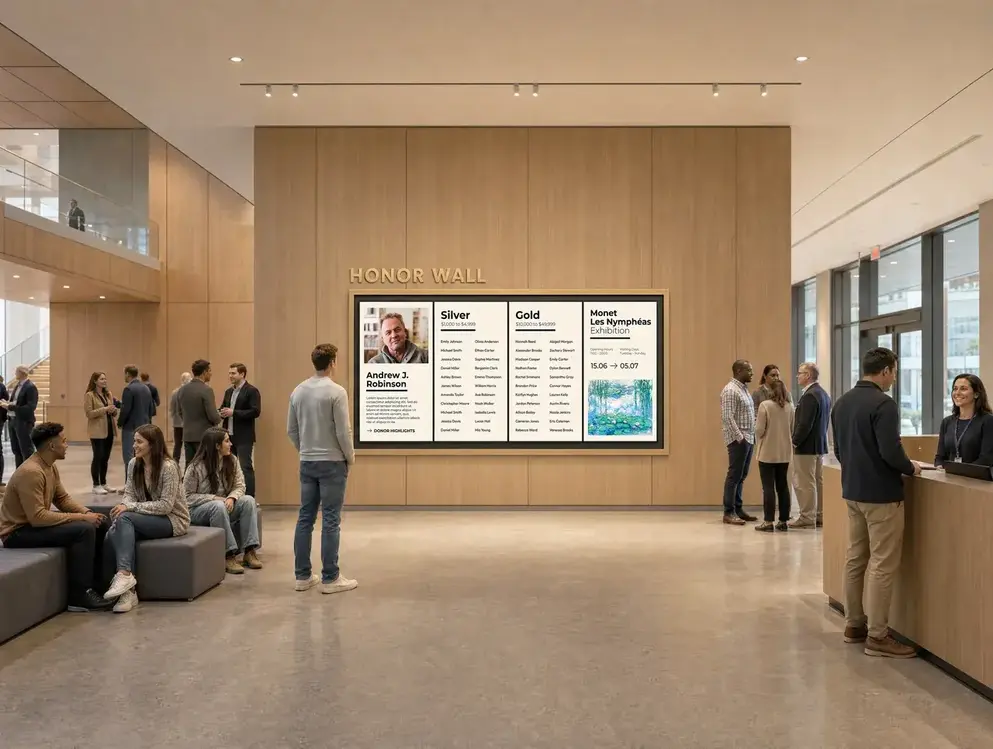
Museum Donor Walls and Donor Recognition for Theaters, Orchestras, and Zoos: Digital Donor Wall Ideas for Arts and Culture
LeeAnn Lowery / Updated October 15, 2026
Donor recognition in a cultural organization renews by the season. Members come up for renewal every year, sponsors sign on show by show, a named seat or a named gallery is given once and remembered forever, and the people who gave are back in the lobby on opening night to see whether anyone noticed.
A museum, a performing arts center, an orchestra, and a zoo each run that cycle on a different calendar, with different donors to honor and a different building to honor them in.
This guide takes them one at a time: what donor recognition looks like in each, the moments the wall has to be ready for, what belongs on it, where it goes, and what a digital donor wall changes.
OmniAlly designs, builds, and installs digital donor walls, donor boards, and donor plaques for museums, performing arts centers, theaters, orchestras, zoos, aquariums, and botanical gardens, on displays drawn for the buildings they sit in, with names that update from the organization's own ticketing and donor systems.
What Arts and Culture Philanthropy Shares
Arts and culture philanthropy is different from a hospital or a university campaign in three ways that shape the wall, and the same three hold for a public library, a science center, or a civic arts center. First, it is membership driven. Most of the names on the wall renew every year, so a wall that cannot change every year is wrong from the day it is installed. Second, sponsors are donors.
The company behind this season, the foundation behind this exhibition, and the family behind this production all expect to be recognized on the night it matters, and that night is on the calendar months ahead. Third, the audience comes back.
A subscriber sees the lobby thirty times a season, a member walks through the atrium every month, and a family passes the same exhibit sign every summer. The wall is seen more often than any donor wall in any other sector, so the engagement it earns is real, and it gets stale faster.
Traditional recognition in these buildings is engraved or printed: a brass plaque on a seat back, etched glass panels and dimensional letters in the lobby, printed acrylic panels for the donor lists, a vinyl sponsor logo on the exhibition wall that is scraped off when the show closes, a bronze plaque at the exhibit, a brick in the garden path.
Each one is fabricated once and fixed in place, each one is costly to change, and each one is wrong by the next season. A digital donor wall holds the same names as content on a screen, or several screens, in a custom frame, so the recognition keeps the organization's calendar and the storytelling that engraved panels cannot hold: the donor's photograph, the gift's story, the building it made possible.
The sponsor of tonight's performance is on the lobby wall tonight, the exhibition sponsor changes when the show changes, a new member appears the week they join, and the capital campaign that built the building stays on the same wall beside this season's names. The donor wall ideas guide covers donor recognition wall ideas in general.
The rest of this guide is specific to each kind of cultural organization.
Museum Donor Walls: Galleries, Exhibitions, and Members
What museum donor recognition looks like
A museum donor wall usually begins with the capital campaign that built or expanded the building: the founders, the leadership gifts, and the named galleries, wings, and courtyards.
Around it sit the recognition programs that run every year: members by level, the annual fund, exhibition sponsors, and the donors of works of art, who are often recognized on the object label and nowhere else.
A museum donor wall has to carry money and objects, a one-time campaign and an annual membership, in a building where the art is supposed to be the only thing on the wall.
The museum calendar: five moments
- An exhibition opening. The sponsors and the lenders are recognized the night the show opens, and the recognition changes when the next show opens, without scraping vinyl off a wall.
- The members' preview. Members see the show before the public, and the wall in the atrium shows the membership levels and this year's new members on the night they feel most like insiders.
- The gala. The biggest giving night of the year, with the table sponsors and the fund-a-need donors recognized the same week.
- A gallery dedication. A named gallery, wing, or courtyard opens with the family present, and the recognition at the gallery entrance carries the name, the story, and what the space holds.
- The expansion campaign. The next capital campaign opens on the same wall that honors the last one, with the goal, the case, and the first names, and the progress updates as pledges come in.
Museum donor wall ideas
A digital donor wall in the atrium or the lobby that carries the capital campaign by level, members by level, and this year's annual fund, drawn for the architecture, the lighting, and the wayfinding signage around it rather than taken from a catalog.
Digital donor plaques at the entrance to each named gallery, with the family's name, their story, and the works the gallery holds, which change as the installation changes. Exhibition sponsor recognition that lives on the same display and turns over with the show.
A timeline wall for the museum's history, its directors, and its collection, so visitors see the institution and not only its donors. A membership wall where a new member appears the week they join and a member who moves up a level moves on the wall.
Placement in a museum
The atrium, the lobby, or the corridor to the galleries, where every visitor passes and where the art is not.
Museums are careful about anything that competes with the collection, so the wall belongs in the public circulation space where visitors pause, and its design should defer to the building: the finishes, the lighting, and the typography of the museum's own signage.
A corporation's logo belongs on the exhibition sponsor panel for the run of the show, in the museum's typography, and comes down with it. Named gallery recognition belongs at the gallery threshold, not inside the room, so the plaque introduces the space without sharing the wall with the work.
Gifts of art, anonymous gifts, and lenders
A donor who gives a painting is recognized on the object label and should also be recognized on the wall, in the same giving society as a donor who gave the money to buy one. Because the recognition is content, a gift of art can carry an image of the work.
An anonymous gift is listed as Anonymous at its level, counted in the total without a name, or left off, and the choice can change later. A lender to an exhibition is recognized with the show and retired with it.
Performing Arts Centers and Theaters
What theater donor recognition looks like
A theater's recognition runs on three lists. Season sponsors and production sponsors, who are companies and foundations and expect their names on the lobby wall on opening night. Named seats, which families give once in a capital campaign and come back to find for decades.
And the annual fund and the membership, which renew every year and fill the lobby wall with the names that pay for the season. A performing arts center that hosts a dozen companies adds the resident companies and the building's own capital campaign.
The theater calendar: five moments
- Opening night. The production sponsor is on the lobby wall before the house opens, the season sponsors are beside them, and the wall turns back to the full donor list after the run.
- The season announcement. The new season goes up with the sponsors who made it possible and the ask for the ones still needed.
- A seat dedication. A family names a seat, in memory or in honor, and the dedication goes up on the lobby wall the same week, searchable by name and by seat.
- Intermission. Fifteen minutes when the whole audience is in the lobby with a drink and nothing to look at. The wall carries the campaign, the sponsors, and the stories while they wait.
- The gala. The honorees, the table sponsors, and the paddle-raise donors are recognized the same week, and the gala's goal runs on the wall the night of.
Theater donor wall ideas
A lobby donor wall that turns to tonight's sponsor at curtain and back to the full list after the run. A digital named-seat wall where a visitor searches by name or by row and finds the dedication, the photograph, and the story, so a seat plaque campaign does not end when the brass plaques run out.
Production sponsor recognition scheduled a season ahead, so the development office sets it once. A history wall with the theater's productions, its artistic directors, and its building campaigns, so the wall honors the institution's story alongside its donors' generosity. For a performing arts center with several resident companies, one wall with a panel for each company's donors on the same display.
Placement in a theater
The lobby, the mezzanine, or the donor lounge, never the house. Lobbies are the busiest donor recognition spaces in any sector, with the whole audience passing through twice a night, so the wall is sized for a crowd reading at a distance, and it is placed where people pause: the bar, the concessions line, the stairs to the balcony.
Ticketing and donor data in one list
Theaters run their donors and their ticket buyers in the same system more often than any other sector, usually Tessitura, and the wall updates from it. A subscriber who becomes a donor moves onto the wall from the same record, a sponsor is recognized from the same list the box office sees, and the development office never keeps a separate spreadsheet for the lobby.
Orchestras, Opera, and Ballet
What recognition looks like for a performing company
A symphony, an opera company, or a ballet company often performs in a hall it does not own, so its recognition has to work in a lobby it shares, at its own offices and donor lounge, and on the night of a performance. The lists are the subscribers who give, the musician chair sponsors, the guest artist and production sponsors, the endowed chairs and funds, and the legacy society that keeps the company alive between seasons.
The company calendar: four moments
- Opening night of the season. The season sponsors, the chair sponsors, and the leadership donors are recognized as the subscribers arrive.
- A chair dedication. A family endows the principal cello chair, and the recognition carries the family, the musician who holds the chair this season, and the story, and it changes when the musician does.
- A memorial for a longtime subscriber. A gift in memory of someone who sat in the same seat for forty years goes up with a photograph and the family's words.
- The gala and the annual fund drive. The goal runs on the wall, and the thanks follow the same week.
Ideas and placement
A musician chair wall that pairs each sponsored chair with the musician who holds it, updated each season. A subscriber and donor wall by giving society. A legacy society wall for planned gifts. A history wall with the company's music directors, premieres, and seasons. The wall lives in the lobby of the hall by agreement with the hall, in the company's donor lounge, or at its offices where major donors visit, and the same donor list runs all of them.
Zoos, Aquariums, and Botanical Gardens
What recognition looks like outdoors
A zoo or a garden recognizes donors across acres rather than a lobby. Exhibit naming, animal and plant sponsorships, memorial benches, engraved bricks on the path, a tree dedicated to a grandparent, and the capital campaign that built the new habitat all live outside, in sun and rain, where an engraved plaque fades and a brick heaves. Members are the base of the donor list, and the families who visit every summer are the audience.
The garden calendar: four moments
- An exhibit or habitat opening. The sponsors and the campaign donors are recognized at the exhibit the day it opens, with the story of the animals or the plants it holds.
- The spring opening and the member nights. The membership levels and this year's new members are honored at the entrance when the season begins.
- A memorial bench or tree. A dedication goes up at the spot the family chose, with the photograph and the words, and it returns on the dates they pick.
- The brick campaign. Every brick already dedicated stays, and the campaign keeps room for every brick still to come, without an engraver.
Ideas and placement
An outdoor digital donor wall at the entrance for the capital campaign and the membership. Outdoor digital donor plaques at exhibits, benches, and gardens for the named gifts. Digital donor bricks for the path campaign. A digital donor monument at the main gate where the dedication and the photographs happen. All of it is built for direct sunlight and weather, and all of it runs on the same donor list as the wall inside the visitor center.
How Much Does a Museum or Theater Donor Wall Cost?
OmniAlly publishes starting prices for every recognition product on its pricing page and for outdoor products on its outdoor pricing page, with installation included in the starting price and a software license after.
A single-screen board is the entry point, a multi-screen wall scales up from there, and adding names costs nothing, so a membership that renews every year never becomes a fabrication order. Most cultural organizations budget the wall inside the capital campaign it recognizes, and the wall keeps working for every season after it.
Who Builds Digital Donor Walls for Museums, Theaters, and Zoos?
OmniAlly builds digital donor walls, digital boards, digital plaques, and outdoor donor recognition for museums, performing arts centers, theaters, orchestras, opera and ballet companies, zoos, aquariums, botanical gardens, and other cultural nonprofits, designs each one for the building it sits in, and runs these recognition systems on its own donor wall software.
The wall integrates with Tessitura, Salesforce, Raiser's Edge NXT, Blackbaud CRM, DonorPerfect, Bloomerang, Virtuous, Neon CRM, Bonterra, and other donor management systems, so members, subscribers, and sponsors update automatically from the list the organization already keeps.
Content is scheduled by the organization's own team from a cloud dashboard, a season at a time, or OmniAlly's White Glove Experience handles updates for them, with a typical turnaround of four business hours.
Products by room: the digital donor board for one lobby, the digital donor wall for the atrium or the main lobby, digital donor plaques for named galleries and seats, and the donor experience center when the donor lounge should carry the whole case for support.
Renderings show the wall in the actual lobby or at the actual exhibit before anything is built.
Arts and Culture Donor Wall FAQs
What is a museum donor wall?
A museum donor wall is the public recognition a museum gives the donors who built or expanded the building, named its galleries, sponsored its exhibitions, and renew as members every year. A digital museum donor wall carries all of them as content on a display in the atrium or the lobby, so exhibition sponsors change with the show, new members appear the week they join, and the capital campaign stays on the wall beside this year's names.
How does a theater recognize season sponsors and production sponsors?
On the lobby wall, on the night it matters. A digital lobby wall turns to tonight's production sponsor at curtain, carries the season sponsors beside it, and turns back to the full donor list after the run, with the whole season scheduled ahead by the development office.
Can a name-a-seat campaign be digital?
Yes. A digital named-seat wall in the lobby lets a visitor search by name or by row and find the dedication, the photograph, and the story behind the seat, and a new seat dedication goes up the same week. The brass plaque on the seat back can stay, and the campaign no longer ends when the plaques run out.
How does an orchestra recognize donors when it does not own its hall?
In the lobby of the hall by agreement with the hall, in the company's own donor lounge, or at its offices where major donors visit, all on the same donor list. A musician chair wall pairs each sponsored chair with the musician who holds it this season and changes when the musician does.
Does a zoo or a botanical garden donor wall work outdoors?
Yes. OmniAlly's outdoor digital donor walls, plaques, bricks, and monuments are built for direct sunlight and weather, so exhibit naming, memorial benches, tree dedications, and brick campaigns are recognized where they happen, and the whole campus runs on the same donor list as the wall inside the visitor center.
Can the wall update from Tessitura?
Yes. Donor and subscriber lists update automatically from Tessitura, Salesforce, Raiser's Edge NXT, Blackbaud CRM, DonorPerfect, Bloomerang, Virtuous, Neon CRM, Bonterra, and other donor management systems, so the development office never keeps a separate list for the lobby wall.
How are gifts of art and anonymous gifts recognized?
A gift of art is recognized on the object label and on the wall, in the same giving society as a gift of money, with an image of the work if the museum chooses. An anonymous gift is listed as Anonymous at its level, counted in the total without a name, or left off, and the choice can change later with nothing to re-engrave.
How much does a museum or theater donor wall cost?
OmniAlly publishes starting prices for every recognition product on its pricing page, with installation included and a software license after. A single-screen board is the entry point, and adding names costs nothing, so a membership that renews every year never becomes a fabrication order.
Where should a donor wall go in a museum or a theater?
In the atrium, the lobby, the mezzanine, or the donor lounge, where every visitor passes and where the art and the stage are not. Named gallery recognition belongs at the gallery threshold, and outdoor recognition belongs at the exhibit, the bench, and the gate. OmniAlly's renderings show the wall in the actual space before anything is built.
Who builds digital donor walls for museums, theaters, orchestras, and zoos?
OmniAlly designs, builds, and installs digital donor walls, donor boards, donor plaques, and outdoor donor recognition for museums, performing arts centers, theaters, orchestras, opera and ballet companies, zoos, aquariums, and botanical gardens, and documents completed projects on its case studies page.
Wrapping Up: Recognition That Keeps the Season
A museum, a theater, an orchestra, and a zoo do not need the same donor wall. They need a wall that keeps their own calendar: the show that opens, the seat that is named, the chair that is endowed, the exhibit that opens in spring.
A digital donor wall can do that for every season, every sponsor, and every member, on one wall designed for its own building. Thoughtful donor recognition in a museum, a theater, or a garden is an act of gratitude that visitors see every day, and it should inspire the next gift.
See OmniAlly's case studies for completed projects, or talk to OmniAlly about yours.