
In the world of nonprofit fundraising, having donation tiers is necessary for measuring benchmarks and capital campaign progress. Establishing donation tiers will also help you in managing your donors and giving them the recognition they deserve based on their gift size. To help you even further with donor management, creating donor-level names for every tier is a great idea.
In the world of nonprofit fundraising, having donation tiers is necessary for measuring benchmarks and capital campaign progress. Establishing donation tiers will also help you in managing your donors and giving them the recognition they deserve based on their gift size. To help you even further with donor management, creating donor-level names for every tier is a great idea.
Nonprofits often spend too much time scratching their heads trying to come up with appropriate names, but we’ve got some strategies that will help you create the perfect donor-level names for your nonprofit.
How Many Tiers Should You Have on Your Online Donation Page?
Before coming up with creative donor-level names, first, your organization needs to decide how many donation tiers to establish. At the beginning of the process, look at the online donation forms of a few other nonprofits in your industry and use that data as a benchmark.
Once you have an idea of how other nonprofits have set up their tiers for online donations, your next step is to pull data from your CRM to determine your organization’s average gift size. If your organization receives gifts as low as $1 and as high as $5 million, then you should adopt a higher number of donation tiers: 10 or more.
Let’s look at an example.
A program with 12 tiers might be structured like this:
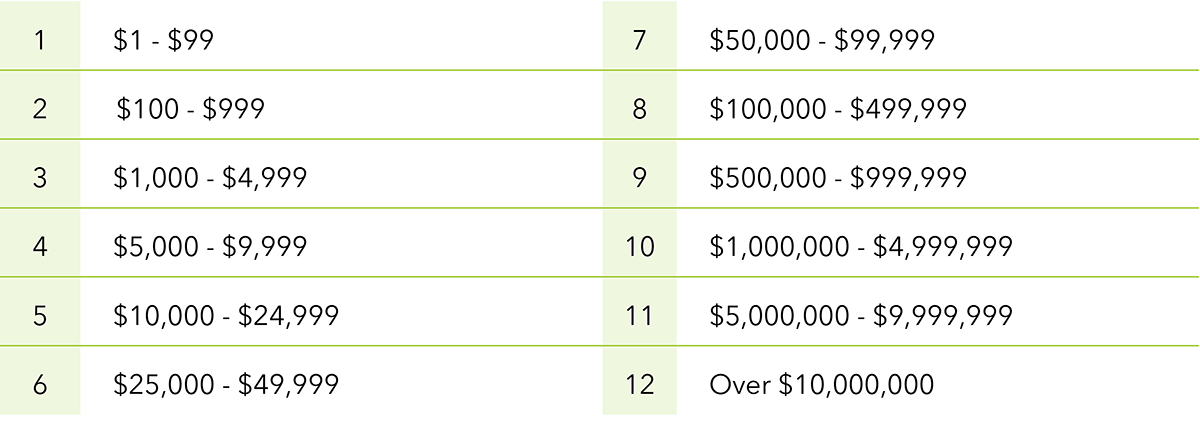
If the average donation amount is in the higher range, say $10,000 to $1 million, then three or four donation tiers may be all you need.
It’s also important to remember that if you establish a targeted donor stewardship plan to execute, and you appropriately recognize your donors, the number of donation tiers will not matter as much as the execution of the plan.
Ensuring that all donors on every donation tier feel appreciated and know that their gifts are contributing to your mission is a critical part of your donor stewardship plan. Recognizing donors at low and high levels, whether it be through digital donor walls or communication, will increase donor retention and bring in more major donors.
Donor Level Names: How to Choose the Right Names for Your Organization
There are a few ways to decide on donor-level names. If you don’t want to invest a lot of time in coming up with names, you could simply use the gift size to determine the names.
Another option is to use a specific branch of your capital campaign to create names. For example, an animal welfare organization may have donation tiers such as “The Animal Welfare Relief Society,” “The Veterinary Support Team,” and “The Community for Wildlife Protection.”

You can save your organization a lot of time and thought by using these tiers as names for giving levels. If you are looking for other ideas, you could use examples based on metals, flowers, sports rankings, or even famous local people.
Donor-level names can also influence how often donors give. If you do have an established hierarchy, long-term donors may have the most “prestigious name,” while monthly and annual donors may be on a recurring payment schedule and have different names. Another helpful idea is to create a title for one-time donors who are not yet ready to graduate to a monthly giving program.

Donor Level List Ideas & Guide
A comprehensive guide to donor-level names including list ideas and a guide of best practices.
This is not to say that donors who give monthly or at lower levels should not have enticing names, but proudly recognizing donors at higher levels is expected.
Finally, your donor-level names should reflect your brand and mission. For example, if you are a nonprofit that strives to help underprivileged teens become involved in sports, consider names such as “MVP,” “All-Star,” “Rookie,” and “Super Fan.” Don’t be afraid to get creative with your names and have fun!
Where to List Your Donor Level Names
When prospective donors decide to donate to your annual fund or capital campaign, be transparent with them and list the donation tiers alongside the donor-level names on your website. If it is listed nowhere else on your site, at least make sure the names are listed on the online donation form or your donation page.

It is crucial to your campaign success and fundraising efforts to make your online donation form as accessible as possible, and proudly displaying the giving level names will also help your nonprofit reach its fundraising goals.
Digital donor walls are a modern and aesthetically appealing tool to use to display your donation tiers and corresponding giving level names. By utilizing digital signage, you have the opportunity to explain to prospective donors why their gift matters to your mission, and they can also see how you choose to publicly recognize your donors.
Donor Level Names FAQs
What are donor levels?
Donor levels, also called giving levels, donor tiers, or donation tiers, are the gift ranges a nonprofit sets to group its donors, each with its own name. A donor's level decides how they are recognized, from the listing on the donor wall to the stewardship they receive.
What are some examples of donor level names?
Common donor level names climb in a clear order: Friend, Supporter, Patron, Benefactor, and Founder, or Bronze, Silver, Gold, Platinum, and Diamond. Giving societies often use Founders Circle, Leadership Society, and President's Circle, with a Legacy Society for donors who make a planned gift.
What are some creative names for donor levels?
Creative donor level names come from your mission. A theater might use Understudy, Player, Director, and Producer; a land trust Trailhead, Ridge, and Summit; a youth sports nonprofit Rookie, All-Star, and MVP; a library Reader, Author, and Editor in Chief. The names work when a donor can tell the order at a glance.
How many donor levels should a nonprofit have?
It depends on the range of gifts you receive. If most gifts fall between $10,000 and $1 million, three or four levels are enough. If gifts run from $1 to $5 million, ten or more levels keep each range meaningful. Set the ranges from your own gift data in your donor database.
What is the difference between a donor level and a giving society?
A donor level is a gift range. A giving society is a named group that donors join by reaching a level or by a kind of giving, such as a leadership society for annual gifts above a set amount or a legacy society for planned gifts. Many nonprofits name their top levels as societies.
Should donor levels and sponsorship levels use the same names?
No. A family in a giving society and a business sponsoring an event are in different programs with different benefits, so each gets its own names and its own recognition, even when the amounts match. Our list of sponsorship level names covers the sponsor side.
Where should donor level names be listed?
List them wherever a donor decides to give or is recognized: the donation page and form, campaign materials, the annual report, and the donor wall. On a digital donor wall, each name appears under its level, and a donor who gives more moves up in real time.
Conclusion
Coming up with donor-level names can be simple if you think of options that are reflective of your brand and campaign goals, or if they correspond with your donation tiers.
Get creative with the names and make it enticing for prospective donors to graduate from one-time donors to long-term donors.
Are you interested in learning more about how you can proudly display your donor-level names using digital solutions? Contact us today!
Donor Level List Ideas & Guide
A comprehensive guide to donor-level names including list ideas and a guide of best practices.
Donor Level List Ideas & Guide
A comprehensive guide to donor-level names including list ideas and a guide of best practices.