Donor Signage Ideas: 20 Donor Recognition Signs, Walls, and Displays
LeeAnn Lowery / Updated October 15, 2026
Donor signage is every sign in and around a building that says who gave: the donor wall in the lobby, the giving-level board by the elevator, the plaque at the door of a named room, the campaign thermometer in the atrium, the sponsor banner at the gala, the monument at the entrance, the bricks on the path, and the small bronze sign on the bench.
Most organizations have all of them, bought one at a time over decades, in five materials and four typefaces, and none of them agree.
The best donor signage ideas, like the best donor wall ideas, start by treating all of it as one recognition program with one design, a cohesive part of the built environment rather than a collection of custom donor walls and donor displays bought one at a time, and then deciding, sign by sign, what should stay engraved and what should become a screen.
OmniAlly designs, builds, and installs digital donor signage, including digital donor walls, donor boards, donor plaques, and outdoor monuments and totems, on displays drawn for the buildings they sit in, with names that update from the donor management system the organization already uses.
What Counts as Donor Signage
A donor recognition program usually runs on six kinds of signs, and each does a different job. Knowing which is which keeps the program from buying the wrong sign for the moment.
- The donor recognition wall. The main recognition in the main room and the focal point of the program: every campaign, every giving level, the founders and this year's donors. Recognition walls are engraved, printed, or digital, and the wall design sets the typography and layout for every other sign.
- The donor board. A single-surface list for one site or one program: the clinic lobby, the branch, the school entrance. Printed boards, perpetual plaques with name plates, or a single screen.
- The plaque. Recognition at a named space or a given thing: the room, the bench, the tree, the equipment. Cast bronze, engraved metal, acrylic, or a small screen in a frame.
- The campaign sign. Fundraising signs that ask: the thermometer, the goal board, the naming-opportunities display, the QR code to the giving page. Temporary by design, and the first thing a digital display replaces.
- The sponsor sign. Logos by level: the banner, the step-and-repeat, the program page, the lobby sponsor panel. Changes with every event and every season.
- The outdoor sign. The monument at the entrance, the totems along the walkway, the plaques in the garden, the bricks on the path. Built for weather, and the hardest to keep current.
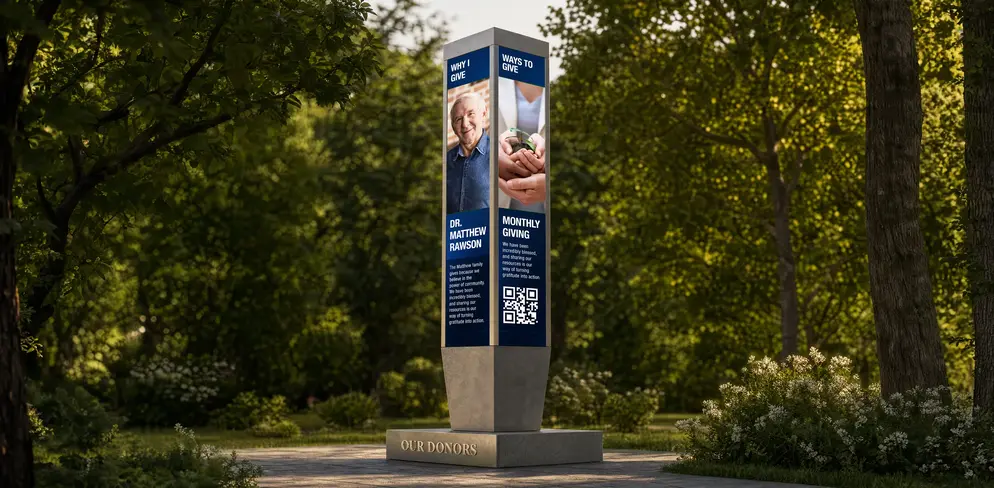
20 Donor Signage Ideas, and the Digital Version of Each
Each idea below works engraved and works on a screen. The second sentence of each says what changes when it is digital, because that is usually the deciding factor.
1. The lobby donor recognition wall
The anchor of the program: one composed surface in the room where donors and guests gather, carrying every campaign and every giving level, designed into the architecture with the graphic language of the organization's brand identity. Interactive elements are optional and added when visitors have time to explore donor stories for themselves.
On a digital donor wall, the names are content, so a new donor appears the week the gift is entered, a donor who moves up a level moves on the wall, and the next campaign opens on the same surface.
2. The giving-level board
A board that lists every donor by society or tier, from the founders circle to annual giving, where visitors pause. On a digital donor board, every level fits on one screen, the list never fills, and a threshold can be set in the software and changed later.
3. Plaques at named rooms
A plaque at the threshold of every named space, in one consistent design, carrying the space, the donor, the reason, and the date. Digital donor plaques add the story, the photograph, and every donor who joined the project, and the inscription updates when a naming term ends. The plaque wording guide covers what each plaque should say.
4. The campaign thermometer
The oldest fundraising sign there is: the goal, the total, and the red line climbing. Printed, it is wrong the day after it is hung. On a digital board, the campaign panel updates as gifts are entered, sits beside the donor list that is driving it, and resets for the next campaign on the same screen.
5. The naming-opportunities display
A sign that shows what is still available to name: the rooms, the courtyard, the scholarship, with the recognition the donor will receive. On a screen it changes as spaces are named, and a prospect can see the plaque that will stand at the door before deciding.
6. The sponsor logo panel
Sponsors by level, logos in color, for the event and the season. A banner is printed per event; a digital sponsor panel on the lobby board turns to the gala's sponsors the week of the event and back to the season's sponsors after. The sponsorship level names post covers the tiers.
7. The donor tree
A tree of engraved leaves on the wall, each leaf a gift, until the leaves run out. A digital donor tree is one of the most common wall designs on a screen: the leaves are names, the tree grows with the campaign, and a leaf can carry a photograph and a story.
8. The memorial and tribute panel
A place for gifts made in memory and in honor, separate from the giving levels, where the person remembered comes first. On a digital wall or plaque, the memorial returns on the dates the family chose and carries a photograph and their words.
9. The donor story screen
Why I Give features, in text, photographs, or a short video of the donor, beside the names. This one has no engraved version. It is the reason organizations go digital, and it is scheduled for visits and events.
10. The impact panel
What the gifts did, in the units that matter: patients, students, meals, acres, performances. Printed once a year in the annual report, or running on the donor wall beside the names all year, updated as the numbers change.
11. The honor roll and hall of fame
Volunteers by hours, board chairs by term, the athletes and alumni honored by year. An engraved honor roll adds a line a year; a digital honor roll adds a class a year with photographs and never runs out of wall.
12. The history and timeline wall
The organization's story, its buildings, its leaders, and the gifts from each era, so visitors see the institution and not only the donors. A digital timeline wall is a Donor Experience Center use, and it grows a chapter at a time.
13. The dedication plaque at the building
The cast bronze plaque at the entrance that names the building, the campaign, the board, and the architect. This one usually stays bronze. The digital donor wall inside carries everyone who gave after the plaque was cast.
14. The outdoor monument at the entrance
Recognition at the curb: the campaign and the leadership donors on a freestanding sign that every visitor passes. A digital donor monument carries the same recognition on a weatherproof display in a custom structure, and the names update from the office.
15. Totems along the walkway
A route of markers between the parking lot and the door, each carrying a campaign, a giving society, or a story. Digital donor totems turn the walk in into the introduction, and the content changes for the morning of an event.
16. Plaques at benches, trees, and gardens
The small outdoor signs for the gifts that dedicate a bench, a tree, or a garden. Cast bronze lasts outdoors; the outdoor digital donor plaque adds the photograph and the memorial date, and several gifts can share one spot.
17. The brick path
Engraved bricks on the walkway, one per gift, until the path ends. Digital donor bricks run the same campaign on a display at the path, with a photograph and a story on each brick and no last brick.
18. Seat and chair plaques
The small plaque on a seat back in a theater or a stadium, given once in a capital campaign and found by families for decades. A digital named-seat wall in the lobby lets a visitor search by name or row and find the dedication and the story.
19. Etched glass, dimensional letters, and vinyl
The architectural signage of recognition: etched glass panels in the lobby, individual letters in stainless steel or maple for the founders, printed acrylic for the giving societies, a vinyl sponsor logo for the exhibition. Craftsmanship and material choice carry these, and the fabrication is done once. Keep them for what is permanent, and put what changes on the screen beside them.
20. The QR code on every sign
A small code on the wall, the plaque, or the thermometer that takes a visitor to the giving page or the donor story. On a digital sign, the code is part of the content and changes with the campaign it points to.
Donor Signage Design, Installation, and Placement Rules
- One signage program. The donor recognition wall, the boards, the plaques, and the outdoor signs share one typography, one layout, one color palette, and one naming style, and they integrate with the building's wayfinding signage and brand identity. Recognition that looks like it came from six vendors over twenty years reads as six vendors over twenty years.
- Readable from where people stand. A lobby wall is read from fifteen feet, a plaque from arm's length, a monument from the curb. Type size, contrast, and the number of names per surface follow the distance.
- Placed where people pause, not where they pass. The main lobby, the corridor to the auditorium, the donor lounge, the entrance of each site. Never inside the sanctuary, the gallery, the patient floor, or the client waiting area.
- Accessible by design. Mounting heights a seated visitor can use, content that plays on its own so nobody has to touch a screen to see the names, and contrast that holds for older eyes.
- Durable where it has to be. Cast bronze and sealed outdoor displays outside; engraved metal, acrylic, glass, and indoor screens inside.
- Installed with the building team. Power, data, mounting, and finishes planned with the architect, so the recognition is part of the built environment rather than added to it, whether the sign is bronze, acrylic, or a display.
- Current. The one rule engraved signage cannot keep. A sign that is a year out of date tells the newest donors their gift did not count.
Donor Signage Materials: What Each Does Well
| Material | Best for | Adding a name later | Stories, photos, video |
|---|---|---|---|
| Cast bronze | Building dedications, outdoor plaques, permanence | A new casting | No |
| Engraved metal, acrylic, or glass | Indoor walls and plaques on a budget | A new panel or plate | No |
| Dimensional letters, stainless steel, wood, and etched glass | Founders, naming the building, architectural recognition | Fabrication | No |
| Printed boards, banners, and vinyl | Campaign signs, event sponsors, exhibitions | Reprint | No |
| Digital donor signage | Everything that changes: names, levels, campaigns, sponsors, stories | From the dashboard or the donor database | Yes |
The practical split: bronze and architectural signage for what is permanent, and digital donor signage for everything that changes. Most organizations keep the dedication plaque and the founders' letters, and move the donor lists, the campaign, the sponsors, and the stories to screens.
How Digital Donor Signage Changes the Program
Digital donor signage is a display, or several, in custom frames drawn for the building, running on donor recognition software rather than a general digital signage platform. Digital donor displays still stand as permanent architectural features, and the recognition on them is content: donor names by level, campaign milestones, storytelling, and the photographs and video that engraving cannot hold.
- One list runs every sign. The wall in the lobby, the board at the branch, the plaques at the doors, and the monument at the entrance all draw from the same donor list, so a name is added once and appears everywhere it belongs.
- The signs keep the calendar. The gala's sponsors the week of the gala, the campaign total as pledges land, the memorial on its anniversary, the dedication the day the term turns over.
- Nothing is re-fabricated. A typo, a changed name, a new level, a renovation that moves the wall: the content changes and the frame stays.
- Stories live beside the names. Photographs, a short video, the impact numbers, the case for the next campaign, and the generosity of new donors recognized the week their new gifts land, which is what inspires future gifts.
- Updates come from the office. From a cloud dashboard, from Raiser's Edge NXT, Salesforce, DonorPerfect, Blackbaud CRM, and other donor management systems, or from OmniAlly's White Glove Experience.
See all of OmniAlly's indoor donor recognition and outdoor donor recognition products, and starting prices on the pricing page. The donor wall ideas guide goes deeper on the wall designs themselves.
Who Builds Digital Donor Signage?
OmniAlly designs, builds, and installs digital donor walls, digital donor boards, digital donor plaques, digital donor bricks, and outdoor donor monuments and totems for hospitals, universities, arts organizations, faith communities, senior living communities, and other nonprofits, designs each sign for the place it stands, and runs the whole program on its own donor wall software.
Its donor recognition is used by organizations such as Baptist Health, Colorado Northwestern Community College, Crossover Mission, and the St. Agatha-St. James Newman Center, and renderings show every sign in its actual place before anything is built.
Donor Signage FAQs
What is donor signage?
Donor signage is every sign that recognizes the people who gave: the donor wall, the giving-level board, the plaques at named rooms, campaign and fundraising signs, sponsor panels, and the outdoor monuments, totems, bricks, and bench plaques. Digital donor signage carries the same recognition as content on displays in custom frames, updated from the donor database.
What are good donor recognition signage ideas?
A lobby donor wall, a giving-level board, plaques at named rooms, a campaign thermometer that updates itself, a sponsor logo panel, a donor tree, a memorial panel, a donor story screen, an impact panel, an honor roll, a history wall, an outdoor monument, walkway totems, bench and garden plaques, and a brick path. The list above gives twenty, each with its digital version.
What is the difference between a donor wall and a donor sign?
A donor wall is the main recognition in the main room, usually several surfaces or screens built into the architecture. A donor sign is any single piece of recognition: a board, a plaque, a monument, a banner. Most programs run one wall and many signs, and a digital program runs all of them on one donor list.
What should fundraising signs show?
The goal, the total so far, what the money builds, and how to give, with a QR code to the giving page. A printed thermometer is out of date the day after it is hung; a campaign panel on a digital donor board updates as gifts are entered and sits beside the names of the donors who are driving it.
Which donor signs should stay engraved?
The building dedication plaque, the founders' names in dimensional letters, and the bronze plaques at benches and trees that are meant to outlast everyone. Everything that changes, meaning donor lists, giving levels, campaigns, sponsors, memorial dates, and stories, does better on a screen.
Where should donor signage go?
Where people pause: the main lobby, the corridor to the auditorium, the donor lounge, the entrance of each site, and the curb for outdoor recognition. Not inside the sanctuary, the gallery, the patient floor, or the client waiting area. OmniAlly's renderings show each sign in its actual place before anything is built.
Can donor signage work outdoors?
Yes. Cast bronze has always worked outdoors, and OmniAlly's outdoor digital donor walls, monuments, totems, plaques, and bricks are built for direct sunlight and weather, so the entrance, the walkway, the garden, and the path run on the same donor list as the wall inside.
How much does donor signage cost?
Engraved and bronze signage is priced per sign and per change, so the cost grows with every name. OmniAlly publishes starting prices for every digital recognition product on its pricing page, with installation included and a software license after, and adding names costs nothing.
Can we keep our existing donor signs and add digital?
Yes. Most organizations keep the engraved wall and the bronze plaques for the campaigns they honor and add digital donor signage for everything since. The names on the old signs can be carried onto the screens as content, so the history and the current list share one program.
Who builds digital donor signage?
OmniAlly designs, builds, and installs digital donor walls, boards, plaques, bricks, monuments, and totems for hospitals, universities, arts organizations, faith communities, senior living communities, and other nonprofits, and documents completed projects on its case studies page.
Wrapping Up: One Program, Not Twenty Signs
Treat every donor sign as part of one program with one design, a cohesive expression of the organization's culture of philanthropy rather than twenty separate recognition projects. Keep bronze for what is permanent, and move what changes, the lists, the levels, the campaign, the sponsors, and the stories, to digital donor signage that runs on one donor list and keeps the calendar on its own. See OmniAlly's case studies for completed projects, or talk to OmniAlly about yours.