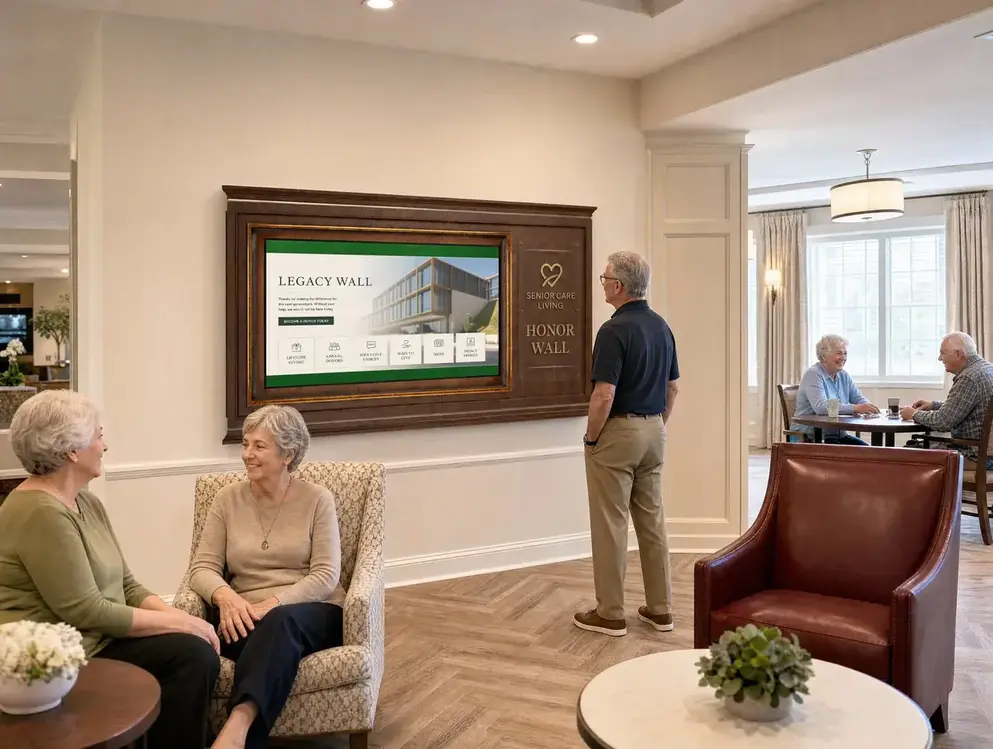
Donor Walls for Senior Living Communities: Digital Donor Recognition for Life Plan Communities, Assisted Living, Memory Care, and Hospice
LeeAnn Lowery / Updated October 15, 2026
In senior living, the donors and the community are the same people. The resident who funded the wellness center walks past it every morning. The family that gave in memory of a mother still visits her friends on the third floor. The staff member honored by the employee appreciation fund serves the people who gave to it.
Donor recognition in a senior living community is read by the people it names, every day, for the rest of their lives, and it has to be designed for that.
This guide covers life plan communities and their foundations, assisted living, memory care, and skilled nursing, faith-affiliated senior ministries and multi-campus systems, and hospice and palliative care: what donor recognition looks like in each, the moments the wall has to be ready for, what belongs on it, where it goes, and what a digital donor wall changes.
OmniAlly designs, builds, and installs digital donor boards, donor walls, and donor plaques for senior living communities, senior care foundations, and hospice organizations, on displays drawn for the buildings they sit in, with names that update from the donor management system the foundation already uses.
What Every Senior Living Community Shares
Four things set senior living apart from every other kind of donor recognition. First, the donors live here. A resident sees the wall on the way to dinner, so a missing name, a misspelling, or a list that is a year out of date is noticed by the person it affects, and by their neighbors.
Second, memorial and tribute gifts are the largest share of giving. A gift in memory of a spouse, a parent, or a friend down the hall is how most families give, and the recognition has to honor the person remembered as much as the person who gave.
Third, the funds are specific.
A benevolent care fund that supports residents who outlive their resources, an employee appreciation fund that stands in for the tips staff cannot accept, a chaplaincy fund, a capital campaign for the new memory care wing, and a legacy society for residents' estate gifts each have their own donors and their own rules about what can be said.
Fourth, the readers are older. Type size, contrast, dwell time, and the height of the display matter more here than in any lobby in any other sector.
Engraved recognition and what a digital wall changes
Traditional recognition in a senior living community is a plaque wall by the dining room with engraved names on acrylic or brass panels, a memorial tree with engraved leaves in the chapel vestibule, bronze plaques at named rooms, and a printed list of the year's donors in the newsletter.
The plaque wall fills up, the tree runs out of leaves, and a resident who gave last month waits a year for the next engraving order.
A digital donor board holds the same recognition as content on a display in a custom frame, so a tribute gift is honored the week it is made, a memorial returns on the anniversary the family chooses, the annual fund resets without an engraver, and the type can be as large as the residents need.
The donor wall ideas guide covers donor recognition wall ideas in general. The rest of this guide is specific to senior care.
Life Plan Communities and Their Foundations
What recognition looks like at a life plan community
A life plan community, also called a continuing care retirement community, usually has its own foundation, a development director, a resident-led philanthropy committee, and a giving program that mirrors a small college: an annual fund, a benevolent care fund, a capital campaign every decade or so, named spaces, and a legacy society whose members are residents who have included the community in their estate plans. The donors are the residents, their families, and the local community that will move in someday.
The recognition problem is scale across time. A community that opened forty years ago has forty years of donors, most of whom have died, and families who come back to find a parent's name. It also has this year's annual fund, which is current for exactly one year. Both lists belong on the wall, and neither should crowd out the other.
The calendar: five moments
- The annual fund drive. Usually run by the residents' own committee in the fall, with a goal, a date, and a celebration. Every donor is on the board the week it closes.
- A named space dedication. A resident or a family names the wellness center, the library, or the garden, and the recognition at the door carries the name, the story, and the campaign that built it.
- The legacy society luncheon. Residents who have made estate gifts are honored while they are alive to see it, and the recognition stays after.
- The remembrance service. Most communities hold one each year for the residents who died. The memorial gifts made in their names are recognized the same week.
- A capital campaign. The next expansion opens on the same board that honors the last one, with the goal, the case, and the names as pledges come in.
Donor wall ideas for a life plan community
A lobby donor board that gives the legacy society its own panel, with the residents' own words about why they gave. An annual fund panel by giving level that resets each year while the capital campaign and the named spaces stay. A cumulative giving panel that honors lifetime giving across decades, so a resident's fortieth gift counts with the first.
A benevolent care panel that shows what the fund made possible this year, by the number of residents supported, never by name. A founders and history panel for a community decades old, with the buildings and the people from each era. Digital donor plaques at named spaces, carrying the family and the story.
Placement in a life plan community
The main lobby, the commons, or the corridor to the dining room, where every resident passes at least twice a day and where visiting families enter. The board is mounted lower than in a hospital lobby, because many residents read it seated or from a walker, and it sits where there is room to pause without blocking the corridor. Named-space recognition belongs at the threshold of the space, not inside it.
Assisted Living, Memory Care, and Skilled Nursing
What recognition looks like where care is the mission
In assisted living, memory care, and skilled nursing, the giving is smaller and more personal than at a life plan community, and much of it comes from families after a stay. A daughter gives in memory of her father to the unit that cared for him.
A family funds a piece of equipment, a sensory room, a courtyard, or a piano. The staff are honored through an employee appreciation fund, because families want to thank the aides who cannot accept gifts, and a holiday fund drive is often the biggest giving moment of the year.
Many of these communities have no development office at all, and the recognition is managed by an administrator or a life enrichment director who needs it to be simple. A board that updates from the parent organization's donor system, or that an administrator can change from a desk, is the right fit.
The calendar: four moments
- The employee appreciation fund drive. Families give in November and December, and the fund's donors and the staff it honors are recognized together before the holidays.
- A memorial gift after a stay. The family's gift goes up with a photograph and their words, in the weeks after the funeral, when they are still coming back to visit.
- An equipment or courtyard dedication. The family that funded it is recognized at the spot, with what it does for residents.
- Family council and open house. The building is full of families who have not given yet, and the board shows them who has and what it changed.
Ideas and placement
A single-screen digital donor board in the main lobby or at the entrance to the dining room, with a memorial panel, an employee appreciation panel that names the donors and honors the staff as a group, and a panel for the courtyard, the equipment, and the named rooms.
In memory care, the board lives in the family entrance or the lobby outside the secured unit, not inside it, so it is read by the families and the staff rather than residents who may find it confusing. Memorial content is gentle: a photograph, a name, the family's words, and nothing that counts.
Faith-Affiliated Senior Ministries and Multi-Campus Systems
What recognition looks like across a system
Many senior living providers are faith-affiliated ministries or nonprofit systems with several campuses, one foundation, and donors who care about the mission as much as a building. A Lutheran, Methodist, Catholic, Jewish, or Presbyterian senior ministry raises money for chaplaincy, for benevolent care across every campus, and for the system's founding purpose, from congregations, from residents, and from families who have moved from one campus to another. The recognition has to work at each campus and still show the whole.
The calendar: four moments
- Founders Day or the anniversary. The system's history, its founding congregation or order, and the donors from each era are honored across every campus the same week.
- The chaplaincy and benevolent care appeal. The mission funds have their own drive, and their donors are recognized with what the funds did, in the units that matter: residents supported, services held.
- A campus opening. A new campus opens with the system's donors on the board from day one, and the campus's own donors added as they give.
- The remembrance service. Held at each campus, with the memorial gifts recognized there and in the system-wide list.
Ideas and placement
One donor list that runs on a board at every campus, with a panel for the system's mission donors and a panel for each campus's own, so a family that moved from one community to another finds their parent's name at both. A chaplaincy and spiritual care panel at the chapel vestibule, never in the chapel itself. An employee giving panel, because staff at a faith-based ministry give to the mission too and are rarely recognized for it.
A founders panel with the congregation or the order and the people from each era. Content managed from the foundation office and the same on every campus the same day.
Hospice and Palliative Care
What recognition looks like at a hospice
A hospice raises most of its money from the families it served, after the death, and nearly all of it is memorial giving. The tree of lights at the holidays, the memorial garden, the butterfly release, and the remembrance wall are the hospice's recognition programs, and they are about the person who died first and the gift second. A hospice house adds a capital campaign and named rooms, and a hospice foundation adds a legacy society and corporate partners.
The calendar: four moments
- The tree of lights. The holiday memorial campaign, where each light is a gift in memory of someone, is the largest giving event of the year, and the names belong on the wall as the lights go on.
- A memorial gift after a death. The family's gift and the name of the person remembered go up in the weeks after, with a photograph if the family wants one.
- The annual remembrance service. Families return, and the wall carries every name from the year.
- A hospice house room dedication. A family names a patient room, and the recognition at the door carries the name and the story.
Ideas and placement
A memorial wall in the hospice house lobby or the family room that shows the people remembered, in turn, with the families' words, and a donor panel beside it for the tree of lights, the annual fund, and the legacy society. An anniversary feature that brings a name back on the date the family chooses.
For the memorial garden, outdoor donor recognition built for weather and direct sunlight, so the garden's dedications are honored where they happen. Placement is in the lobby and the family room, never on the patient floor, and the content is quiet: large type, slow changes, nothing that counts money.
Designing a Donor Board for Older Readers
Whatever the community, five design rules hold for senior living donor recognition.
- Large type and high contrast. Names set bigger than any other lobby would use, in typography with no thin faces, dark on light or light on dark, and no color pairs that fade for aging eyes.
- Slow changes. Content that stays long enough to be read by someone who reads slowly, and moves gently when it moves.
- Mounted at a seated eye line. Lower than a hospital lobby board, because residents read it from a chair, a walker, or a wheelchair.
- Non-touch or simple touch. Most senior living boards are read, not operated. If the community wants search, it should be a large, simple control that a resident can use to find a friend's name.
- Impact stories, briefly. One sentence on what the benevolent care fund covered or what the courtyard changed does more to inspire giving than any list, and it fits beside the names.
- Dignity first. Benevolent care recipients are never named. Memorials carry a photograph and the family's words, not an amount. A resident's name appears while they are alive to see it and stays after.
How Much Does a Senior Living Donor Board Cost?
OmniAlly publishes starting prices for every recognition product on its pricing page and for outdoor products on its outdoor pricing page, with installation included in the starting price and a software license after.
A single-screen donor board is the entry point, which fits most senior living lobbies, and adding names costs nothing, so an annual fund with hundreds of resident gifts never becomes a fabrication order. Many communities fund the board with a single named gift from a resident or a family who wants the recognition itself to be their legacy.
Who Builds Digital Donor Boards for Senior Living Communities?
OmniAlly builds digital donor boards, digital donor walls, digital plaques, and outdoor donor recognition for life plan communities, assisted living, memory care, skilled nursing, faith-affiliated senior ministries, multi-campus senior care systems, and hospice organizations, designs each one for the building it sits in, and runs these recognition systems on its own donor wall software.
The board integrates with Raiser's Edge NXT, Salesforce, DonorPerfect, Bloomerang, Blackbaud CRM, Virtuous, Neon CRM, Bonterra, and other donor management systems, so memorial and tribute gifts update from the list the foundation already keeps.
Content is scheduled by the foundation's own team from a cloud dashboard, or OmniAlly's White Glove Experience handles updates for them, with a typical turnaround of four business hours.
Products by room: the digital donor board for one lobby or common area, the digital donor wall for a main entrance or a capital campaign, digital donor plaques for named rooms and gardens, and the donor experience center when the foundation office should carry the whole case for support.
Renderings show the board in the actual lobby before anything is built.
Senior Living Donor Recognition FAQs
What is a senior living donor wall?
A senior living donor wall is the public recognition a community gives the residents, families, staff, and neighbors who fund its annual fund, its benevolent care and employee appreciation funds, its capital campaigns, and its memorial and tribute gifts. A digital senior living donor wall carries all of them as content on a display in the lobby or the commons, with type sized for older readers, a tribute honored the week it is made, and memorials that return on the anniversaries families choose.
How do you recognize benevolent care fund donors without naming the residents it helps?
Recognize the donors by name and giving level, and show what the fund did by the number of residents supported and the care it covered, never by who received it. A digital board keeps the two apart on separate panels and keeps the count current.
How are memorial and tribute gifts recognized in a senior living community?
With the name of the person remembered first, a photograph if the family wants one, the family's words, and the donor's name, and without an amount. On a digital board the memorial goes up in the weeks after the death and returns on the anniversary or the birthday the family chooses.
Can an employee appreciation fund be recognized on the donor board?
Yes. The donors to the fund are named, and the staff it honors are recognized as a group, with the drive's total and the dates, so families see that their thanks reached the people who cared for their parent.
Where should a donor board go in a senior living community?
In the main lobby, the commons, or the corridor to the dining room, mounted at a seated eye line, where residents pass twice a day and families enter. In memory care it goes in the family entrance or the lobby outside the secured unit, and in hospice it goes in the lobby or the family room, never on the patient floor. OmniAlly's renderings show the board in the actual space before anything is built.
Should a senior living donor board be a touchscreen?
Usually not. Most senior living boards are read rather than operated, and a non-touch display with large type and slow changes serves residents best. If the community wants search, a large, simple control that finds a friend's name is enough.
Can one donor list run on boards at several campuses?
Yes. A multi-campus system runs one donor list across every campus, with a panel for the system's mission donors and a panel for each campus's own, managed from the foundation office and current on every campus the same day.
Can the board update from our donor management system?
Yes. Donor lists update automatically from Raiser's Edge NXT, Salesforce, DonorPerfect, Bloomerang, Blackbaud CRM, Virtuous, Neon CRM, Bonterra, and other donor management systems, and OmniAlly confirms the connection for any system that is not listed before anything is signed.
How much does a senior living donor board cost?
OmniAlly publishes starting prices for every recognition product on its pricing page, with installation included and a software license after. A single-screen donor board is the entry point and fits most senior living lobbies, and adding names costs nothing.
Who builds digital donor boards for senior living communities and hospices?
OmniAlly designs, builds, and installs digital donor boards, donor walls, donor plaques, and outdoor donor recognition for life plan communities, assisted living, memory care, skilled nursing, faith-affiliated senior ministries, multi-campus systems, and hospice organizations, and documents completed projects on its case studies page.
Wrapping Up: Recognition the Donors Will Read Every Day
A life plan community, a memory care unit, a faith-based senior ministry, and a hospice do not need the same donor board. They need a board that keeps their own calendar: the annual fund close, the holiday employee fund, Founders Day, the tree of lights.
A digital donor board can do that for every resident, family, and staff member, in type they can read, with the memorials returning when the families want them. See OmniAlly's case studies for completed projects, or talk to OmniAlly about yours.