
A hospital donor wall is a display, usually in a main lobby or in the wing a campaign funded, that recognizes the people, families, and organizations who give to a hospital or health system foundation. It can be a traditional wall of engraved plaques, a digital donor recognition wall that shows names and stories on screens, or a mix of the two. OmniAlly designs, builds, and installs digital donor walls for hospitals and health care foundations such as Baptist Health South Florida and McLaren Health Care.
A hospital donor wall is a display, usually in a main lobby or in the wing a campaign funded, that recognizes the people, families, and organizations who give to a hospital or health system foundation. It can be a traditional wall of engraved plaques, a digital donor recognition wall that shows names and stories on screens, or a mix of the two. OmniAlly designs, builds, and installs digital donor walls for hospitals and health care foundations such as Baptist Health South Florida and McLaren Health Care.
Hospital foundations raise money in conditions no other nonprofit faces. Patient privacy law governs who can be asked and how. Gifts often arrive at the lowest point in a family's life, or just after the best news they have had in years.
Acquisition is the sector's named top challenge. In the 2026 Philanthropy Pulse survey from CCS Fundraising, 71 percent of health organizations put it first, and only 34 percent kept even 45 percent of their newly acquired donors. Recognition is one of the few tools that works on both ends of that problem, and a hospital donor wall is where recognition becomes visible: a way to thank donors in public, to celebrate generosity, and to inspire future generosity from the people walking past.
This guide covers what a hospital donor wall is, what makes recognizing donors different in a hospital, the moments the wall should be ready for, HIPAA, what to put on it, placement, cost, and who installs one.

What Is a Hospital Donor Wall? Recognition Walls, Plaques, and Displays
A hospital donor wall, sometimes called an honor wall, a wall of gratitude, or a donor recognition display, lists the donors to a hospital foundation, usually grouped by giving level or by campaign. It is the public half of donor recognition; the private half is the thank-you call, the letter, and the visit.
Hospital donor walls come in four forms, and most campuses end up with more than one.
- Traditional donor recognition wall. Names engraved in a glass wall, cast in bronze, or printed on metal plaques, mounted in a lobby. Traditional donor walls hold still, which is their promise and their limit: adding a name means new fabrication.
- Digital donor recognition wall. One or more commercial displays in a custom enclosure, showing donor names, giving levels, impact stories, and campaign updates from software the foundation controls. Names change the week a gift lands, which allows for easy updates across a campaign.
- Digital donor plaques. Small digital displays beside a named room, unit, or garden that carry the donor's name, a photo, and a line about the gift, in place of an engraved plaque.
- Donor boards. A single screen in a clinic lobby, a cancer center, or a children's wing that cycles through the donors to that unit, so recognition lives where the care happens and not only at the front door.
The right mix depends on the campus, and scalability matters: the software should run one screen or forty. A health system with six hospitals may run one digital wall at each main entrance and digital plaques on every named room, all updated from one dashboard. A community hospital may need a single donor board in the lobby that is designed to grow into a full digital donor wall after the next campaign.
Why Recognizing Donors Is Different in a Hospital
Four things set effective donor recognition apart in a hospital, and each one shapes what the wall has to do.
The grateful patient. Most hospital giving starts with care. A patient or a family wants to thank the people who treated them, and the foundation's job is to make that possible. The sector has spent the last few years arguing about how: the American College of Physicians' 2023 position paper says physicians should not be asked or expected to solicit their own patients as a condition of employment, and the Association of Fundraising Professionals has condemned bonuses tied to patient referrals. Recognition sidesteps the argument. Nobody has to ask a patient for anything for the wall to say thank you once a gift has been made, and a feature on the wall is the one grateful-patient touch nobody calls intrusive.
Privacy law. HIPAA decides what the foundation can know and use. It does not restrict what the donor wall can show, because the wall shows donor information, not patient information, but it does shape how patient stories are gathered. More on that below.
The second gift. First-year retention in health philanthropy is among the lowest in the nonprofit sector, and a first gift that goes unacknowledged in public rarely turns into a second one. A wall that shows the name within days, and a photo sent to the donor that week, is the most direct answer a foundation has.
Planned gifts and legacy donors. Hospitals draw a larger share of their support from bequests and other planned gifts than most nonprofits do. In the Association for Healthcare Philanthropy's Report on Giving, planned giving accounted for 11 percent of private support to the 210 hospitals and health organizations surveyed, more than special events. Legacy donors are recognized while they are alive and honored after, which means a hospital donor wall needs a legacy society section that grows slowly, can hold a line of tribute for each member, and never has to come down for a renovation.
Employee giving. Hospital employees are donors too, and at scale: AHP notes that non-physician employees, nurses among them, make up about 20 percent of all individual donors to U.S. hospitals, even though their gifts rarely exceed 4 percent of the funds raised. Employee campaigns live and die on visibility inside the building, and a wall that recognizes units, departments, and the people who gave, in the hallways those people walk every shift, is the recognition that keeps participation up year after year.
Turnover and renovation. Gift officers move, and so do walls. Healthcare fundraising has a staffing problem that CCS Fundraising describes as disrupting donor relationships and stalling campaigns, and hospitals renovate constantly, which displaces plaque walls; practitioners on the Blackbaud community forum describe hallways full of plaques with nowhere to go after a renovation. A digital donor recognition wall survives both, because the recognition lives in the database and the software, not in the officer's head or on a wall that is coming down.
Six Hospital Moments a Donor Wall Should Be Ready For
A hospital donor wall earns its keep at a handful of moments in the foundation's year. Plan for them before the wall is designed, because each one decides what the wall shows and what a person does next.
- The grateful-patient window. A family's gratitude peaks at discharge, at a remission milestone, or at the end of treatment, and it fades fast. When a gift arrives in that window, the name goes up that week, and the acknowledgment carries a photograph of the wall and an invitation to come see it on the next visit.
- The caregiver tribute. A gift made in honor of a nurse, a physician, or a unit becomes a feature on the wall that names the donor and the caregiver, never the patient's condition. The caregiver is told their name is on the wall. It is the moment that turns clinicians into the program's allies.
- The renovation. A capital project takes down the old plaque wall. The digital wall carries the legacy names forward, era by era, so no family arrives to find a grandparent's name gone.
- The gift-officer handoff. When an officer leaves, the successor's first calls are easy when they start with recognition: "your feature is still up, come see it with me." The wall is the relationship that does not resign.
- The endowed fund's annual report. Each named fund's story for the year, the equipment bought and the nurses trained, runs as a feature on the wall, and the family is invited to see it rather than mailed a report that took four weeks to assemble.
- Gala night. The sponsor logos for the night, the paddle-raise total as it climbs, and the names of the evening's donors on the wall before the room empties, with the ten-months-later renewal in mind.
The pattern is the same at each moment: the wall does its part, and a person does hers. That is stewardship, and it is how a wall strengthens relationships instead of recording them. Foundations that plan the person's part, the photo, the invitation, the call, are the ones whose walls change giving instead of decorating a lobby.
Grateful-Patient Recognition Without the Ask: The Caregiver Tribute
The caregiver tribute deserves its own section because it solves the hospital's hardest recognition problem. Many foundations already run an honor-your-caregiver or honor-a-nurse program, where patients and families give in the name of someone who cared for them. On a digital donor wall, each of those gifts becomes a feature: the donor's name, the caregiver's name and unit, a photo of the caregiver, and a line from the family if they offer one. Patient status never appears. The development officer, not the physician, makes the only call: the tribute is live, come see it. The honored clinician is told, which is the update that consultancies such as Marts and Lundy say referring clinicians stop getting when a program breaks down.
Gratitude flows through the caregiver, so no physician solicits, no chart is screened at the bedside, and the wall becomes something the clinical staff want to show visitors. On a traditional plaque wall this program is impossible at any volume; on a digital wall it is a content type, with a new tribute added in minutes.
HIPAA and a Hospital Donor Wall
Three things are true at once, and foundations get into trouble by collapsing them into one.
- The donor wall shows donor information, not protected health information. A name, a giving level, a photo the donor supplied, and words the donor approved are donor data. HIPAA governs patient data. The vendor that builds and runs your donor wall should never receive PHI, and the data feed from your donor database should carry gift records only.
- HIPAA's fundraising rule governs how the foundation finds grateful patients. Under 45 CFR 164.514(f), a covered entity may use limited patient information for fundraising, including demographic information, dates of care, the department of service, the treating physician, and outcome information, and every fundraising communication must give the recipient a clear way to opt out. That is the foundation's compliance work, upstream of the wall.
- Patient stories on the wall need written authorization. If a patient outcome story, a photo of a patient, or a quote from a family appears on the wall, HIPAA requires the patient's signed authorization, and good practice adds a plain-language explanation of where the story will run and for how long. Caregiver tributes avoid the issue by featuring the caregiver and the donor and never the patient's condition.
Put those three in the recognition policy, have compliance sign off once, and the wall stops being a HIPAA question at all.
What to Put on a Hospital Donor Wall
Content is what makes a hospital donor wall more than a list. Here are the three jobs the wall can do, with the content that fits each.

Recognizing Donors
Recognition is the first job of every donor wall, traditional or digital. Honor donors by name and giving level, and go further where the format allows:
- Donor names grouped by recognition levels or donor tiers, with the donor's preferred name exactly as approved, so every name reads the way the donor wants it
- A donor spotlight that rotates featured donors
- Donor profiles for major donors: their connection to the hospital and their reason for giving, in their own words
- Why I Give stories on video, the most direct way to show appreciation and let major gifts speak in the donor's own voice
- Caregiver tributes and memorial and in-honor gift stories
- The impact of a specific gift: the scanner, the room, the program it funded
- Quotes from staff whose work a gift made possible
- Corporate, foundation, in-kind, and giving society partners, and a sponsor rotation for events
On a digital donor recognition wall, a donor who upgrades to a new giving tier moves automatically, a misspelling is fixed from a browser, and a story can run for a season and then step aside for the next campaign.
Showing Impact

Beyond recognition, the wall is the most visible place a foundation has to show what philanthropy buys. When visitors see the direct line between a gift and better care, the case for giving makes itself.
- Campaign progress: a live thermometer for a new wing, or funding milestones for a piece of equipment
- Before and after: photos or video of the renovated space, the new equipment in use, the staff it supports
- Numbers that quantify the difference: patients served, beds funded, scholarships awarded to nursing staff
- Patient outcome stories: short narratives or video of patients whose care a gift changed, with written authorization and a respectful edit
- Staff testimonials: doctors, nurses, and researchers on what a gift lets them do
Telling the Hospital's History

A hospital's history is a history of generosity, and the wall can showcase it to create a lasting legacy and a sense of community around the institution. A milestone timeline of breakthroughs and capital projects, the founding story and the original benefactors, archival photos and footage, and a legacy section that carries forward the names from every plaque wall the building has ever had. For a century-old institution, this is also how the wall survives the next renovation: the names move to the screen before the wall comes down.
Design Elements and Placement: Custom Donor Recognition Crafted to Honor the Building
A hospital is a harder room than a lobby at a university. The design elements that matter most:
- Placement. The main entrance for the campaign wall; the unit or wing for the donors who funded it. Donor boards in a cancer center or a children's wing put recognition where the care happens, and a recognition display at the end of a tour route lets the development officer finish a visit in front of the names.
- Touch, or no touch. Interactive features let visitors search by name and open stories, and they belong where families linger and tours end. Walk in with eyes open, though: a touchscreen in a hospital lobby is touched hundreds of times a day, so it comes with a cleaning schedule, infection-control sign-off, and usually an antimicrobial screen coating. Where that is more than the foundation wants to manage, or where children pass all day, a non-interactive digital wall with a QR code for giving does the same work with nothing to wipe down.
- Accessibility. Touch controls within the 2010 ADA Standards reach range of 15 to 48 inches, a 30 by 48 inch clear floor space, and no more than 4 inches of protrusion into a corridor for a wall-mounted enclosure, which is why hospital walls are usually recessed or carried to the floor.
- Legibility and glare. Donor names are the content. Choose typography sized for the viewing distance, keep strong contrast, and position the digital screens so lobby glass and overhead lighting do not wash them out.
- Materials and brand. Custom designs crafted to honor the building: an enclosure in the hospital's own palette, premium materials where the lobby is premium, so the wall reads as part of the architecture and creates a space that honors the people in it.
- Resilience. Hospital networks are locked down and lobbies lose Wi-Fi. The wall should keep playing without internet and come back showing the donor list after a restart.
How Much Does a Hospital Donor Wall Cost?
Traditional hospital donor walls are priced by fabrication: materials, the number of plaques, design, and installation, plus a new fabrication charge each time names are added, which in a hospital is every month. Digital donor walls are quoted as a project that covers the enclosure, the displays, installation, content, and software, with an annual software license afterward and no per-name charge. The initial investment is higher than a single plaque; the cost of keeping the wall current is close to zero.
A foundation can start with one donor board or a few digital donor plaques and grow into a full wall as a campaign closes. OmniAlly publishes starting prices for every indoor and outdoor product on its pricing page.
Who Installs Digital Donor Walls for Hospitals?
OmniAlly is a digital donor wall specialist. It designs, builds, and installs digital donor walls, donor boards, and digital donor plaques for hospitals and health care foundations, and runs them on its own cloud-based software. Its health care customers range from regional systems to community hospitals such as Margaret Mary Health and Beaufort Memorial Hospital.
The wall integrates with Salesforce, Raiser's Edge NXT, DonorPerfect, Blackbaud CRM, Ellucian, Tessitura, Bloomerang, Blackbaud Luminate, Virtuous, Neon CRM, Bonterra, and any other donor management system, so donor names update automatically. It keeps running without internet and comes back showing the donor list after a restart.
Content Creation and White Glove services keep the stories and the names current when the foundation's staff cannot.
If you are comparing vendors, the guide to choosing a digital donor wall company explains the difference between product companies and project companies and gives eight questions to ask any of them. For the policy side, including giving levels, naming opportunities, and when a name comes down, see the donor recognition handbook.
Hospital Donor Walls FAQs
What is a hospital donor wall?
A hospital donor wall recognizes the donors, grateful patients and families, and sponsors who give to a hospital or health care foundation. It can be a traditional wall with names engraved on plaques, a digital donor recognition wall that shows names and impact stories on screens, or digital donor plaques beside named rooms. Some hospitals call it an honor wall or a wall of gratitude. Digital walls are the easiest to keep current as new gifts and campaigns arrive.
Who installs digital donor walls for hospitals?
OmniAlly designs, builds, and installs digital donor walls for hospitals and health care foundations, including the enclosure, the displays, and the content. Health systems and community hospitals across the country use OmniAlly. The wall updates from the foundation's donor database, including Salesforce, Raiser's Edge NXT, DonorPerfect, and Blackbaud CRM, so recognition stays current without a separate list.
What is hospital donor recognition?
Hospital donor recognition is how a hospital or its foundation thanks the people who give: grateful patients and families, physicians and staff, community members, and local businesses. It includes donor walls and digital donor plaques in lobbies and named spaces, caregiver tributes, giving societies, and recognition at events. It follows the hospital's privacy rules, so a grateful patient appears on the wall as a donor, never as a patient.
How do you recognize donors in a small hospital lobby?
A single-screen digital donor board in a corner, or a designed feature that fits the room, provides full donor recognition without an imposing installation. The same software can later drive a full digital donor wall or digital plaques on named rooms as the foundation grows.
Can a hospital donor wall recognize grateful patient and tribute gifts?
Yes. Grateful patient gifts, honor-a-caregiver tributes, memorial gifts, giving societies, and the sponsors behind every campaign can all appear on a digital donor wall. A tribute or memorial gift can be honored the day it is made, with the donor's name and a line in memory or in honor of the person being recognized, and a caregiver tribute names the caregiver and the donor without disclosing anything about the patient.
Are hospital donor walls HIPAA compliant?
A donor wall shows donor information, which HIPAA does not cover, so the wall itself is not a HIPAA question. HIPAA applies to how the foundation identifies grateful patients, which 45 CFR 164.514(f) permits within limits and with an opt-out, and to any patient story or image on the wall, which needs the patient's written authorization. The donor wall vendor should never receive protected health information.
How does a hospital foundation keep donor recognition current across a campus?
Digital donor recognition runs from one dashboard, so a foundation can keep every building and every wing current from one desk. A donor entered once can appear on displays across the campus, and the list can update automatically from the foundation's donor database.
How much does a hospital donor wall cost?
Traditional walls are priced by fabrication and charged again whenever names are added. Digital donor walls are quoted as a project with an annual software license and no per-name charge. OmniAlly publishes starting prices for every product on its pricing page.
What gift level puts a donor on a hospital donor wall?
Each hospital foundation sets its own, usually from its giving levels: a cumulative giving threshold for a permanent wall, and an annual giving society for a yearly honor roll. On a traditional wall every name has to be fabricated, which pushes thresholds up. On a digital donor wall, names are added in software, so the threshold can follow your donor recognition policy instead of the budget, and an annual honor roll can include every donor.
Where should a hospital donor wall go?
The campaign wall belongs at the main entrance or in the lobby the campaign built, where visitors linger and tours end. Donors to a specific unit are best recognized in that unit on a donor board or digital plaques. Choose a spot with controlled light, a clear floor space in front, and room to grow.
Wrapping Up: A Digital Wall That Celebrates Generosity
A hospital donor wall works when it is planned around the moments a foundation already lives through: the grateful-patient window, the caregiver tribute, the renovation, the officer handoff, the fund report, and gala night. Decide what the wall shows at each one and what a person does next, keep patient information out of it, and choose a wall that can change as fast as the giving does.
If you are planning a digital donor wall for your hospital, reach out to OmniAlly. We will walk through your lobby, your campaign, and your moments, and show you what the wall would look like in your building.

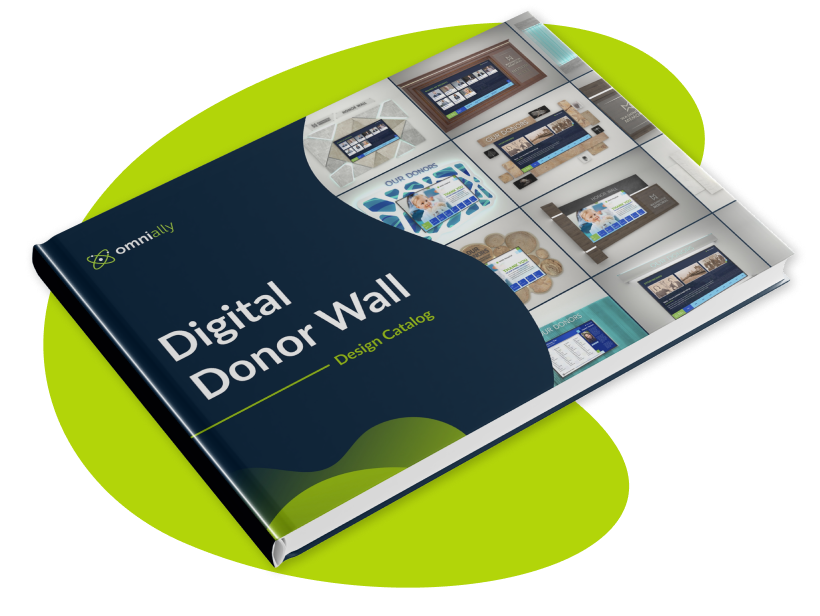
Design Catalog for Digital Donor Walls
Get inspiration from our digital donor wall designs.
Design Catalog for Digital Donor Walls
Get inspiration from our digital donor wall designs.