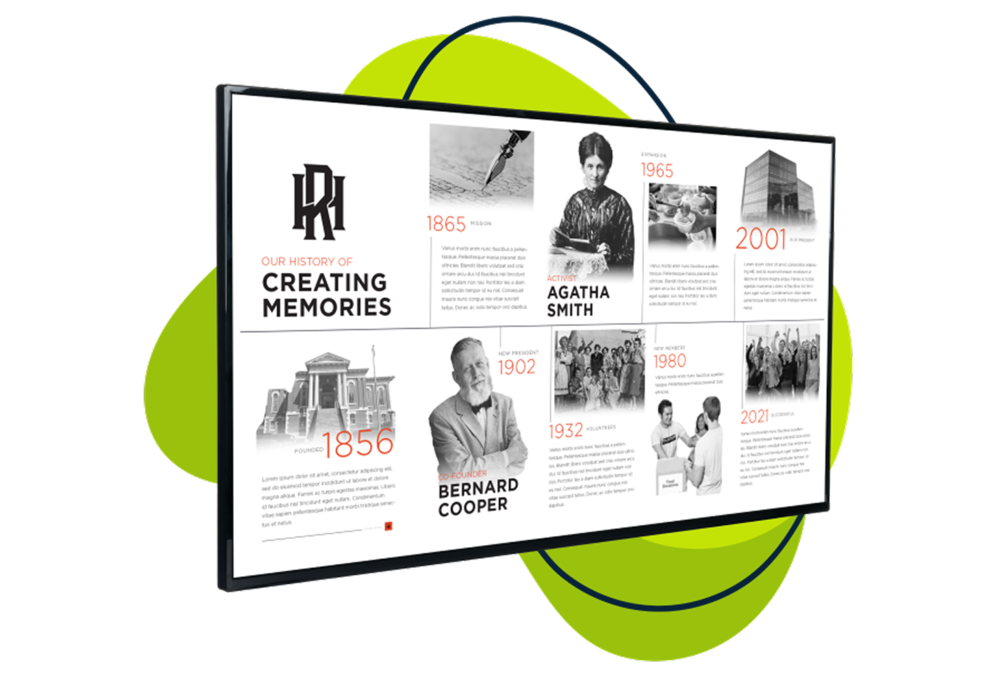
History Wall and Timeline Wall Ideas: 18 Designs, and the Digital History Wall
LeeAnn Lowery / Updated October 15, 2026
A history wall tells visitors who an organization is before anyone has to explain it.
A history wall tells visitors who an organization is before anyone has to explain it.
The founding, the first building, the people who ran it, the campaigns that built it, the moments the community remembers: laid out in order along a corridor or across a lobby, so a new employee, a prospective donor, or a patient's family takes in a century in the time it takes to walk to the elevator.
Most organizations build one for an anniversary, print it on panels, and then watch it stop at the year it was installed.
This guide covers what a history wall and a timeline wall are, when to build one, eighteen history wall ideas, how to write the timeline, the design rules that keep it readable, and what changes when the history wall is digital.
OmniAlly designs, builds, and installs digital donor walls and donor experience centers that carry an organization's history, its donors, and its campaigns on one set of displays drawn for the building, with content that grows a chapter at a time.
What a History Wall Is, and How It Differs From a Timeline Wall
A history wall, also called a heritage wall or a legacy wall, is a permanent display of an organization's story: its founding, its leaders, its buildings, its milestones, and the people who made them happen. A timeline wall, or history timeline wall, is the most common form of it, with the story arranged in a linear sequence along a line, usually by decade, so a viewer gets the overview at a glance and the detail up close.
A history wall can also be arranged by theme, by place, or by person, and the best ones combine a timeline with artifacts, photographs, and the donors whose gifts built each chapter.
They appear in hospital corridors and university alumni centers, in church narthexes and museum lobbies, in community centers and senior living communities, and they are almost always built for an occasion: the centennial, the fiftieth anniversary, the opening of a new building, or the end of a capital campaign that deserves to be the last chapter.
Why build one
- Identity. A visitor learns what the organization has survived and built, the key moments of its evolution, which is the context every ask depends on. It is visual storytelling in the one place everyone passes.
- Donor recognition with a story. A donor wall says who gave. A history wall says what the gifts built, chapter by chapter, and a wall that does both is stronger than either.
- Onboarding and pride. New staff, new students, new residents, and new members walk past it every day, and the institution's culture and brand identity are on the wall. A well-designed history wall communicates the mission faster than any orientation.
- The anniversary itself. A centennial needs a place to happen, and the history wall is where the photographs are taken.
- Present and future. The best history walls end with the vision for the future, so the timeline points at the next campaign rather than stopping at the last one.
18 History Wall and Timeline Wall Ideas
Creating a history wall starts with choosing its form. Each of the timeline wall design ideas below works as printed panels and as a digital display, and the last sentence of each says what changes on a screen.
1. The decade timeline along a corridor
The classic historical timeline display on a wall: a horizontal band at eye level running the length of a hallway, one panel per decade, with the milestones, the photographs, a graphic for each era, and a short caption each. On a digital timeline wall the band runs across one or more screens, scrolls on its own, and the next decade is added without repainting the hallway.
2. The founders wall
The founding story first: the people, the first building, the first year's numbers, the document that started it, with portraits and the founding statement in their own words. Digital, the founders' chapter can carry their letters, the first ledger page, and the founding campaign's donors.
3. The leadership wall
Every president, chief executive, pastor, superintendent, or music director in order, with dates and a line about each one's era. Printed, it needs a new panel at every transition; on a screen the next leader is added the week they start.
4. The milestones and firsts wall
The first graduating class, the first surgery, the first performance, the first service, the first million raised, the day the doors opened after the fire. Firsts make the best captions, and on a digital wall each one can open to the full story.
5. The campaign history wall
The organization's story told through its capital campaigns: each building, each expansion, each endowment as a chapter, with the donors who funded it. This is where the history wall and the donor wall become one.
One community center on its third building in a century had a hundred years of giving to carry across three buildings, with records that were uneven from decades past; the Marcus Jewish Community Center of Atlanta case study shows how a digital wall held all of it and still stayed correctable the following week.
6. The then-and-now wall
Pairs of photographs of the same place or the same program decades apart: the entrance in 1952 and today, the operating room, the chapel, the ballfield. On a screen the pairs can fade from one to the other.
7. The map of growth
A map of the campus, the city, or the service area with each building, branch, or program marked by the year it opened. A digital map adds the next site the day it opens and can show the growth as an animation.
8. The artifact wall
Display cases with the physical objects, the first uniform, the original sign, the cornerstone trowel, the ledger, with the timeline running between them. The cases stay; a screen beside each case carries the object's story and the voice of the person who used it.
9. The oral history wall
Short recorded interviews with the people who were there: the retired nurse, the founding board member, the alumnus from the first class. This has no printed version. On a digital history wall a visitor hears them, and a new interview is added every year.
10. The people wall
Not the leaders: the staff, the volunteers, the long-serving teachers and physicians and ushers, by decade, with their photographs. A printed people wall fills; a digital one keeps adding people.
11. The anniversary wall
Built for the centennial or the fiftieth, with the anniversary year as the last chapter and the celebration's photographs added after the event. Printed, it is finished the day it is hung; on a screen the anniversary becomes chapter one of the next century.
12. The community wall
The organization's story told through the neighborhood, the town, or the region it serves: what was here before, what changed, and how the organization changed with it. Local photographs, local names, and room for the community's own contributions.
13. The honor roll inside the history
Awards, accreditations, championships, recognitions, and the people honored for them, placed in the decade they happened rather than on a separate plaque. A digital honor roll adds each year's honorees in their year.
14. The legacy society chapter
The donors who have included the organization in their estate plans, recognized as part of the future the history wall points toward. A legacy wall idea that belongs at the end of the timeline, and on a digital wall it grows as the society does.
15. The program histories
One chapter per program: the nursing school, the youth sports league, the choir, the research institute, each with its own timeline and its own donors. Several timelines on one digital wall, on one list, chosen by the visitor.
16. The interactive timeline wall
A touchscreen timeline where a visitor scrolls the decades, opens a milestone, watches the film, reads the letter, and finds a name. This is the Donor Experience Center use: a room where the history, the donors, and the case for the next chapter are explored together.
17. The permanent chapters and the living ones
Dimensional letters for the decades and the organization's name, printed or etched panels for the founding era, and screens for the chapters that are still being written. The permanent part stays permanent, and the recent history keeps up.
18. The multi-campus history wall
For a hospital system, a university with several campuses, a faith-based senior ministry, or a federation of community centers: one shared history on a wall at every site, with the system's founding and milestones on one panel and each campus's own chapter beside it. Printed, that is a different wall at every site; on a digital history wall it is one story, one list, and a new site added the day it opens.
How to Write a Timeline Wall
- Gather everything, then choose. Annual reports, board minutes, newspaper clippings, photographs, and the memories of the longest-serving people. Then choose twenty to forty milestones per century. A wall that tries to say everything says nothing.
- Write captions of thirty words or fewer. The year, what happened, who did it, and why it mattered. The longer story goes behind the caption on a digital wall, or in the book.
- Lead with people and photographs. A date and a sentence is a list. A face and a sentence is a story that captivates a visitor who meant to walk past.
- Keep one voice. Plain, specific, and in the present tense for the milestones, so 1952 reads as vividly as last year.
- Include the hard years. The fire, the merger, the closure, the pandemic. An institution that survived something is more worth supporting than one that claims it never struggled.
- Decide who approves. Archives, leadership, and the family of anyone named, with a proof of every panel or screen before it is produced.
- Plan the next chapter before you install this one. Where the next decade goes, who adds it, and what it costs to add. This question decides whether the wall is printed or digital.
History Wall Design Rules
The design process runs from the archive to the installation, and the aesthetics should serve the reading: a museum-quality wall is one a visitor can explore at walking pace.
- Reading direction and pace. Left to right, in the direction people walk, with one milestone every few feet so the wall is read at walking pace rather than studied.
- Scale for the corridor. Headline years readable from across the hall, captions readable from arm's length, photographs large enough to recognize a face.
- One design language. The typography, the colors, and the materials match the building's signage and the donor recognition nearby, so the history wall and the donor wall read as one program.
- Materials. Dimensional letters for the years and the name, print or etched panels, acrylic, wood, and backlit elements for the permanent chapters; displays in custom frames for the chapters that change.
- Lighting. Even light along the whole wall, no glare on glass or screens, and a corridor that is lit after hours if the wall is meant to be seen from outside.
- Placement. The main corridor, the lobby, the alumni center, the narthex, the donor lounge. A history wall is read while walking, so a corridor beats a room, and the Donor Experience Center is where it becomes a room on purpose.
- Room to grow. Blank panels at the end, or a screen, so the wall does not end at the year it was installed.
What a History Wall Costs Over Time
A printed history wall is priced by the panel and then by the reprint. Every leadership change, every anniversary, and every correction is a new panel, and a wall built for the centennial is usually untouched by the time the next decade needs a place.
A digital history wall is built once around the corridor or the room, and the chapters are content, so adding the next decade, the next leader, or the campaign that just closed costs nothing.
OmniAlly publishes starting prices for digital donor walls and donor experience centers, which a digital history wall runs on, on its pricing page, with installation included and a software license after.
The Digital History Wall
A digital history wall is the organization's story as content on displays in custom frames drawn for the building, running on donor recognition software, with the chapters, the photographs, the film, and the donors on one list. It is a digital donor wall use when it runs along a corridor or across a lobby, and a donor experience center use when the history, the donors, and the case for support share a room.
- It never ends at the installation year. The next decade, the next leader, the next campaign, and the anniversary's own photographs are added from the dashboard.
- It carries what panels cannot. Film, oral histories, the founding documents page by page, and the then-and-now pairs that fade into each other, which transforms a decorative timeline into engagement with the story.
- It is interactive when the room calls for it. A touchscreen timeline lets a visitor explore a decade by touch, find a name, and watch the story, and plays on its own for everyone walking past.
- The donors are in the history. Each campaign chapter carries the donors who funded it, from the organization's donor management system, so the history wall and the donor wall are one program on one list.
- It keeps the calendar. Anniversary mode for the centennial year, the founding date each year, the memorial of a founder on its date.
- Updates and corrections take a minute. A wrong date, a misspelled name, or a photograph the family would rather not use is changed without reprinting a panel.
The donor wall ideas guide covers the recognition designs a history wall can sit beside, and the donor signage ideas post covers the rest of the signage program.
Who Builds Digital History Walls?
OmniAlly designs, builds, and installs digital donor walls and donor experience centers that carry an organization's history, its donors, and its campaigns, for hospitals, universities, faith communities, arts organizations, senior living communities, and other nonprofits, draws each one for the corridor or the room it sits in, and runs the content on its own donor wall software.
Its donor recognition is used by organizations such as Baptist Health, Colorado Northwestern Community College, Crossover Mission, and the St. Agatha-St. James Newman Center, and renderings show the wall in the actual space before anything is built.
History Wall and Timeline Wall FAQs
What is a history wall?
A history wall is a permanent display of an organization's story: its founding, its leaders, its buildings, its milestones, and the people and donors behind them, usually along a corridor or across a lobby, and usually built for an anniversary or a new building. A digital history wall carries the same story as content on displays, so chapters are added and corrected without reprinting.
What is the difference between a history wall and a timeline wall?
A timeline wall arranges the story in date order along a line, usually by decade. A history wall is the broader term and can be arranged by theme, place, or person as well as by date. Most history walls include a timeline, and the best add artifacts, photographs, oral histories, and the donors who funded each chapter.
What should a history wall include?
The founding, the leaders, the buildings and campaigns, twenty to forty milestones per century, photographs with faces, the hard years as well as the good ones, the people who served, and room for the next chapter. Captions of thirty words or fewer, with the longer story behind each one on a digital wall.
How do you design a timeline wall?
Left to right in the direction people walk, one milestone every few feet, headline years readable from across the corridor and captions from arm's length, photographs large enough to recognize a face, one design language shared with the building's signage and donor recognition, even lighting, and blank panels or a screen at the end so the wall can grow.
Where should a history wall go?
The main corridor, the lobby, the alumni center, the narthex, or the donor lounge, where people walk and pause. A corridor suits a timeline because it is read at walking pace; a donor experience center suits a history wall that visitors explore.
Can a history wall be interactive?
Yes. An interactive timeline wall on a touchscreen lets a visitor scroll the decades, open a milestone, watch film, hear an oral history, and find a name, and it plays on its own for everyone walking past. OmniAlly builds interactive history walls on its digital donor walls and donor experience centers.
Can a history wall include donors?
Yes, and it should. The capital campaigns that built each chapter are part of the history, and a digital history wall carries the donors of each campaign from the organization's donor management system, so the history wall and the donor wall are one program on one list.
How much does a history wall cost?
A printed history wall is priced by the panel and then by every reprint, and the cost grows with every change. OmniAlly publishes starting prices for digital donor walls and donor experience centers, which a digital history wall runs on, on its pricing page, with installation included and a software license after, and adding chapters costs nothing.
Can a multi-campus organization share one history wall?
Yes. A hospital system, a university with several campuses, or a senior ministry with many communities can run one history on a digital wall at every site, with the shared founding and milestones on one panel and each campus's own chapter beside it, managed from one dashboard and current everywhere the same day.
How do you keep a history wall current?
Decide before installing it where the next decade goes and who adds it. A printed wall needs a new panel for every change; a digital history wall adds the next leader, the next campaign, and the anniversary's photographs from a dashboard, and a correction takes a minute.
Who builds digital history walls?
OmniAlly designs, builds, and installs digital donor walls and donor experience centers that carry an organization's history, donors, and campaigns, for hospitals, universities, faith communities, arts organizations, senior living communities, and other nonprofits, and documents completed projects on its case studies page.
Wrapping Up: A History Wall Should Not End at the Year It Was Hung
Choose twenty to forty milestones, lead with faces, write thirty-word captions, include the hard years, highlight the inspiration behind the founding, and design the wall for the corridor it lives in. Then answer the only question that decides the medium: where does the next chapter go? On panels, it goes nowhere until the next anniversary.
On a digital history wall, it goes up the week it happens, with the donors who made it. See OmniAlly's case studies for completed projects, or talk to OmniAlly about yours.