Donor Walls for Nonprofits: Digital Donor Recognition Ideas for Human Services, Community Centers, Food Banks, and Shelters
LeeAnn Lowery / Updated October 15, 2026
Donor recognition at a nonprofit has to do two jobs at once. It has to thank the people who gave, and it has to show the people who have not given yet what a gift does.
A women's foundation, a YMCA, a food bank, and an animal shelter each do that in a different building, for different donors, on a different calendar.
This guide takes them one at a time: what donor recognition looks like at each kind of organization, the moments the wall has to be ready for, what belongs on it, where it goes, and what a digital donor wall changes.
OmniAlly designs, builds, and installs digital donor walls, donor boards, and donor plaques for human services organizations, community centers, food banks, shelters, housing nonprofits, youth organizations, and animal shelters, on displays drawn for the buildings they sit in, with names that update from the donor management system the organization already uses.
What Every Nonprofit Shares
Three things are true of nonprofit donor recognition no matter the mission. First, the annual campaign is the heartbeat. Most nonprofits raise the money that runs the organization every year, from the same donors, who renew or lapse, so the wall has to change every year or it is wrong by the second one. Second, the capital campaign is the exception. Once in a generation an organization builds or renovates, and the names from that campaign stay for the life of the building.
Third, the donors are not only donors. The volunteer who serves lunch every Tuesday, the corporate partner that sends a team on a service day, the board member who gives and asks, and the family that gives in memory of a parent all expect to be seen, and a list of cash gifts by amount misses most of them. Recognition that works for a nonprofit holds all four: the annual campaign, the capital campaign, the volunteers, and the stories.
Giving levels, major donors, and recognition tiers
Most nonprofits recognize donors by giving level: a named society for major donors, tiers for the annual campaign, a legacy society for planned gifts, and a lifetime giving list. The question every development office asks is where the bottom tier starts. On an engraved wall the floor is set by the fabrication budget.
On a digital wall every giving level fits on one screen, so a first gift and a lifetime gift can share the board, and a threshold, if the organization wants one, is set in the software and changed later.
The tiers that matter most for donor retention are the ones engraved walls skip: the mid-level donor who gives every year, the recurring donor whose monthly gift never reaches a plaque threshold, and the one-time donor whose first gift is the moment to thank them publicly. A wall that recognizes them by name, with the giving level they reached, is a stewardship plan that runs every day.
Types of donor walls: engraved, digital, and virtual
Traditional nonprofit recognition is a physical wall: a plaque wall in the lobby, a donor tree with engraved leaves, donor signs at named rooms, a printed banner for the annual campaign, and a binder of donor stories at the front desk. Each one is fabricated once and corrected by an engraver. A virtual donor wall on the website reaches donors who never visit, and it is a complement to the lobby wall, not a replacement for public recognition in the building.
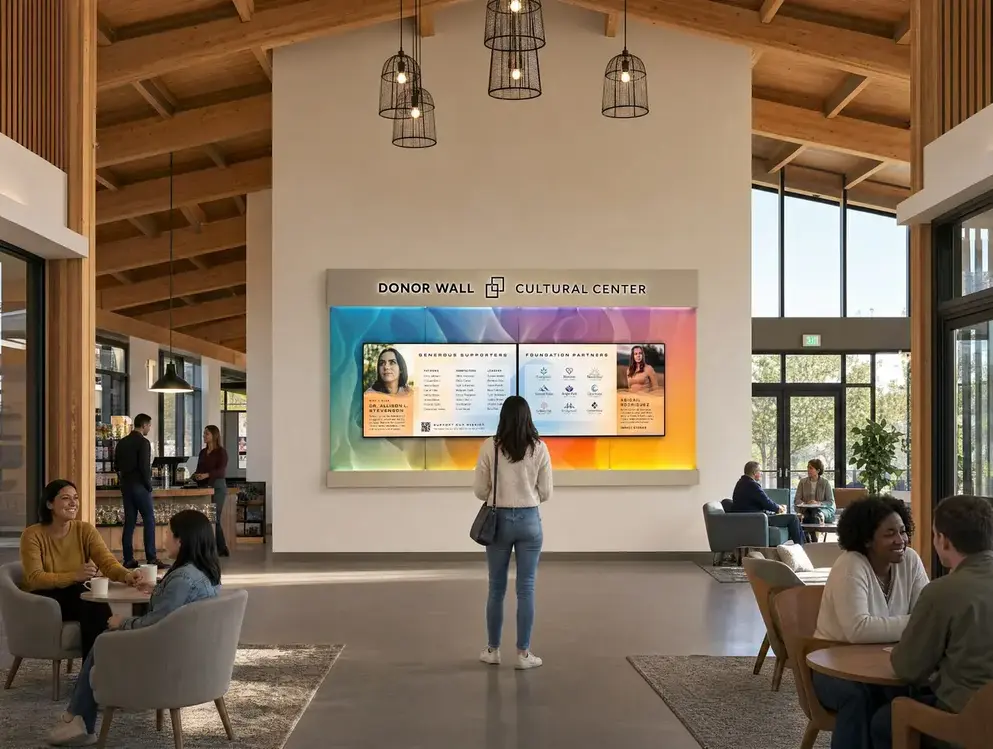
A digital donor wall holds the same recognition as content on a display in a custom frame, so a new donor is added the week they give, the annual campaign resets without a fabrication order, the volunteers get a panel of their own, and a photograph and a story sit beside a name.
The donor wall ideas guide covers donor recognition wall ideas in general. The rest of this guide is specific to each kind of nonprofit.
Human Services Organizations
What recognition looks like in human services
A women's foundation, a family services agency, a counseling center, or a workforce program raises money for people who are rarely in the room when the gift is made. Its donors give to outcomes: a woman who finished the program, a family that stayed housed, a client who found work. The recognition has to carry those outcomes, not only the names, because the story of what the gift did is the reason the next gift comes.
The lists are the leadership society for the largest gifts, the annual campaign by tier, the event sponsors for the gala and the luncheon, the corporate partners, and the legacy society. Many human services organizations have no recognition in the lobby at all, because the lobby was built for clients, and the development office has been waiting for a wall that belongs there.
The calendar: five moments
- The signature event. The luncheon or gala where most of the year's leadership gifts are made. The sponsors are recognized the week of, and the paddle-raise donors join the wall the week after.
- A leadership gift. A donor crosses the top threshold and is recognized with a photograph and a story about what the gift funds, while the gift is still news.
- A board or staff visit with a prospect. The executive director walks a prospective donor through the lobby and the wall carries the case for support, the outcomes, and the names of the people the prospect knows.
- A program graduation. The people the gifts served are in the building, and the wall can honor them with their permission, alongside the donors who made the program possible.
- Year end. The annual campaign closes, the tiers are final, and the wall turns over to the new year without an engraver.
Ideas for a human services donor wall
A lobby donor wall that gives the leadership society its own panel, with a photograph and a short story for each donor at that level, and the annual campaign tiers beside it. An outcomes panel that pairs each giving level with what it funds: a month of counseling, a semester of job training, a year of housing support.
An event sponsor panel scheduled a season ahead. A legacy society panel for planned gifts, with the donors' own words about why. A volunteer honor roll with hours served, because in human services the volunteers are the program.
Placement and the client's dignity
The wall goes where donors, board members, and visitors enter, which is usually the main lobby, the reception area, or the corridor to the boardroom. It does not go in the intake area or the waiting room where clients sit.
A client who came for help should not wait under a wall of other people's generosity, and donors do not expect it.
One human services organization that got this right is Fresh Start Women's Foundation in Phoenix, which had no donor recognition in its lobby and wanted its highest-level Visionary donors honored with more than a name on a list, in a space guests already walk into.
Community Centers: YMCAs, JCCs, and Boys and Girls Clubs
What recognition looks like at a community center
A YMCA, a Jewish Community Center, a Boys and Girls Club, or a recreation center is a building first. It has a gym, a pool, a preschool, a fitness floor, a teen room, and a lobby that thousands of members walk through every week. Its recognition runs on two campaigns: the capital campaign that built or renovated the building, which names the gym, the pool, and the rooms, and the annual campaign that pays for scholarships and memberships for families who cannot afford them.
The annual campaign is the one that makes a community center different. It is run by volunteers, it has a goal and a thermometer, it finishes on a date, and it recognizes hundreds of small gifts from members who give fifty dollars so a neighbor's child can swim. A wall that only lists the capital campaign's leadership gifts tells the members their gifts do not count.
The calendar: five moments
- Annual campaign kickoff. The goal goes up on the lobby wall, the campaign volunteers are named, and the thermometer starts moving.
- Campaign close and the celebration. Every donor at every level is on the wall the week the campaign closes, with the total and what it pays for.
- A named space dedication. A family names the gym or the pool, and the recognition at the door carries the family, the story, and the campaign that built it.
- Member events and open houses. The building is full of people who have not given yet, and the wall shows them who has and what it funded.
- The anniversary. A center that is fifty or a hundred years old has three buildings of history, and the wall can carry all of it.
Ideas for a community center donor wall
A lobby donor wall with the capital campaign by level on one panel and this year's annual campaign on another, so both lists are current at once. A named-space wall or digital donor plaques at the gym, the pool, and the rooms, carrying the family and the story.
A scholarship wall that pairs the annual campaign with the number of families it serves. A history wall for a century-old center, with the buildings, the directors, and the gifts from each era. A volunteer and campaign-chair honor roll.
Placement when children are everywhere
The main lobby or the corridor past the front desk, where every member passes and where the signage program for the building already lives.
Because a community center has a preschool, an after-school program, and children moving through the building all day, a touchscreen is often the wrong choice, and a non-touch display behind a frame built for the building is the right one.
The Marcus Jewish Community Center of Atlanta, a century old and on its third building, replaced engraved wood recognition with three portrait displays behind a single dark oak frame set into an alcove off the main corridor, carrying a hundred years of giving across three buildings and still correctable the following week.
Food Banks, Shelters, and Housing Nonprofits
What recognition looks like where the mission is urgent
A food bank, a soup kitchen, a homeless shelter, a domestic violence shelter, or a housing nonprofit raises money and goods for people in crisis, and its donors are a mix no other sector has. Individual donors give cash. Grocery chains, farms, and manufacturers give food by the ton. Corporations give volunteer shifts. Congregations give both.
A housing nonprofit's donors sponsor a whole home, a wall, or a window. The recognition has to count all of it, in the units that matter: meals, pounds, nights of shelter, homes built.
The calendar: four moments
- The holiday drive. The months when most of the year's food and money arrive, and the corporate partners and congregations that drove them are recognized while the drive is still running.
- A corporate service day. Fifty employees sort food for a morning, and their company is on the wall in the volunteer entrance when they walk in.
- A home dedication or a shelter opening. The sponsor family, the congregation, and the volunteers who built it are recognized at the door the day the keys are handed over.
- The annual report. The year's meals, pounds, nights, and homes go on the wall as a count, next to the donors who made them possible.
Ideas for a food bank or shelter donor wall
A donor wall at the volunteer entrance that recognizes individuals, corporate partners, congregations, and in-kind donors on separate panels, each in its own units. An impact counter that runs the year's meals or nights of shelter beside the donor list. A volunteer honor roll by hours, updated from the volunteer system.
A home sponsor wall for a housing nonprofit, with a photograph of each home and the family that sponsored it. A memorial panel for gifts made in memory, which shelters receive more than most nonprofits.
Placement where clients and donors use different doors
A food bank or a shelter usually has a volunteer and donor entrance and a client entrance, and the wall belongs at the first one. At a shelter, the wall never goes in the residential area or the intake room.
At a food bank it lives at the volunteer check-in, the lobby of the administrative building, or the warehouse entrance where tours begin. Because the building is a working warehouse or a residence, the frame and the display are built for that room, and the content is managed from the development office, not on site.
Youth, Animal, and Environmental Nonprofits
What recognition looks like when the mission has a face
A youth organization, an animal shelter, a wildlife rescue, or a land trust raises money for a mission its donors can see: a child, an animal, a place. Its donors are sponsors as often as they are givers. A family sponsors a kennel, a scholarship, or an acre.
A memorial gift honors a pet or a grandparent who loved the trail. A corporate partner funds a program for a year. Recognition at these organizations works best when it shows the face the gift is for, beside the name of the person who gave it.
The calendar: four moments
- A sponsorship. A family sponsors a kennel, a classroom, or a trail section and is recognized at it, with a photograph, the week it begins.
- A memorial gift. A gift in memory of a pet, a child, or a volunteer goes up with the family's words and returns on the dates they choose.
- The adoption event, the tournament, or the walk. The signature fundraiser's sponsors and top fundraisers are recognized the week of the event.
- A capital campaign for a new facility. A new shelter, clubhouse, or nature center opens with the campaign donors by level at the entrance.
Ideas and placement
A lobby donor wall for the campaign and the annual fund, with a sponsorship panel that shows the kennel, the classroom, or the acre beside the sponsor's name. A pet memorial wall at an animal shelter, where families submit a photograph and a few words and the wall shows them in turn.
A youth achievement panel beside the donor list, so the kids the gifts serve are honored too. For a land trust, a nature center, or a camp, outdoor donor recognition at the trailhead, the pavilion, or the gate, built for weather and direct sunlight.
All of it goes in the lobby or at the entrance, where visitors, adopters, and families pass, and the same donor list runs every display.
Donor Wall Design Best Practices for Nonprofits
The same five practices hold for every kind of nonprofit, whatever the building.
- Recognize new donors fast. A name that goes up the week of the gift is donor stewardship; a name that waits a year for the next engraving order is a reason to lapse. Fast recognition is one of the simplest donor retention tools a development office has.
- Pair the wall with the appreciation event. The reception, the luncheon, and the campaign celebration are where donors see their names for the first time, so the unveiling, the new tier, and the story go up the week of the event. OmniAlly's donor appreciation event themes post covers the event side.
- Put the story beside the name. Donor names alone show who gave. A photograph and two sentences about what the gift did show the next donor why.
- Keep the fundraising goal on the wall. The annual campaign thermometer, the capital campaign total, and the year's meals or nights served belong next to the donor list, because the wall is a fundraising tool as much as an act of appreciation.
- Design for the building, not from a catalog. The frame, the finishes, and the typography should match the lobby and the signage program already in it, and the display should be readable from where visitors actually stand.
- Ask before you honor the people you serve. Clients, residents, and families appear on the wall only with their permission, and never in the spaces built for them.
How Much Does a Nonprofit Donor Wall Cost?
OmniAlly publishes starting prices for every recognition product on its pricing page and for outdoor products on its outdoor pricing page, with installation included in the starting price and a software license after.
A single-screen board is the entry point, a multi-screen wall scales up from there, and adding names costs nothing, so an annual campaign with hundreds of small gifts never becomes a fabrication order.
Most nonprofits fund the wall inside the capital campaign it recognizes, or with a single named gift from a donor who wants the recognition itself to be their legacy.
Who Builds Digital Donor Walls for Nonprofits?
OmniAlly builds digital donor walls, digital boards, digital plaques, and outdoor donor recognition for human services organizations, community centers, food banks, shelters, housing nonprofits, youth organizations, animal shelters, and other charities, designs each one for the building it sits in, and runs these recognition systems on its own donor wall software. Its donor recognition is used by nonprofits such as Crossover Mission, and completed projects are documented on its case studies page.
The wall integrates with Raiser's Edge NXT, Salesforce, DonorPerfect, Bloomerang, Virtuous, Neon CRM, Bonterra, Blackbaud CRM, and other donor management systems, so the annual campaign updates automatically from the list the development office already keeps. Content is scheduled by the organization's own team from a cloud dashboard, or OmniAlly's White Glove Experience handles updates for them, with a typical turnaround of four business hours.
Products by room: the digital donor board for one lobby, the digital donor wall for the main entrance or a campaign, digital donor plaques for named rooms and sponsorships, and the donor experience center when a room should carry the whole case for support. Renderings show the wall in the actual lobby before anything is built.
FAQs About Nonprofit Donor Recognition
What is a nonprofit donor wall?
A nonprofit donor wall is the public recognition an organization gives the donors who fund its annual campaign, built its building, sponsor its programs, and volunteer their time. A digital nonprofit donor wall carries all of them as content on a display in the lobby, so the annual campaign resets every year, a new donor is added the week they give, and a photograph and a story sit beside each name.
How do you recognize donors at different giving levels?
By tier: a named leadership society at the top, annual campaign tiers below it, a legacy society for planned gifts, and a lifetime giving list. On a digital wall every giving level fits on one screen, so a first gift and a lifetime gift can share the board, and any minimum is set in the software and changed later.
How does a YMCA or community center recognize annual campaign donors?
On the lobby wall, every year. The goal goes up at kickoff, the campaign volunteers are named, every donor at every level is on the wall the week the campaign closes, and the list resets for the next year without an engraver, while the capital campaign that built the building stays on its own panel.
Can a food bank recognize in-kind donors and volunteers?
Yes. A digital donor wall gives individual donors, corporate partners, congregations, and in-kind donors separate panels, each in its own units, such as meals, pounds, or hours, and a volunteer honor roll updates from the volunteer system.
Where should a donor wall go at a shelter or a human services organization?
Where donors, board members, and visitors enter: the main lobby, the reception area, or the volunteer entrance. It does not go in the intake area, the waiting room, or the residential area where clients are. OmniAlly's renderings show the wall in the actual space before anything is built.
Should a community center donor wall be a touchscreen?
Often not. A building with a preschool, an after-school program, and children moving through all day is usually better served by a non-touch display behind a custom frame, and the content still changes from the development office.
Can the wall update from our donor management system?
Yes. Donor lists update automatically from Raiser's Edge NXT, Salesforce, DonorPerfect, Bloomerang, Virtuous, Neon CRM, Bonterra, Blackbaud CRM, and other donor management systems, so the annual campaign never lives in a separate spreadsheet for the wall.
How are memorial gifts and anonymous gifts handled?
A memorial gift goes up with the family's words and a photograph, and returns on the dates they choose. An anonymous gift is listed as Anonymous at its level, counted in the total without a name, or left off, and the choice can change later with nothing to re-engrave.
How do you create a donor wall for a nonprofit?
Start with the lists: the capital campaign, the annual campaign by tier, the volunteers, and the stories. Choose the wall for the lobby it will sit in, with a rendering of the actual space. Connect it to the donor management system so the names update themselves. Then set the calendar: the campaign kickoff and close, the signature event, and the dedications the wall has to be ready for.
How does a donor wall help a nonprofit attract donors?
By showing the people who have not given yet what a gift does and who already gave. A wall that carries the fundraising goal, the outcomes, and the names of donors a visitor knows turns the lobby into part of the ask, and recognizing a new donor within the week is one of the simplest ways to keep them.
How much does a nonprofit donor wall cost?
OmniAlly publishes starting prices for every recognition product on its pricing page, with installation included and a software license after. A single-screen board is the entry point, and adding names costs nothing, so an annual campaign with hundreds of gifts never becomes a fabrication order.
Who builds digital donor walls for nonprofits?
OmniAlly designs, builds, and installs digital donor walls, donor boards, donor plaques, and outdoor donor recognition for human services organizations, community centers, food banks, shelters, housing nonprofits, youth organizations, and animal shelters, and documents completed projects on its case studies page.
Wrapping Up: Recognition That Keeps Up With the Mission
A women's foundation, a YMCA, a food bank, and an animal shelter do not need the same donor wall. They need a wall that keeps their own calendar: the luncheon, the annual campaign close, the holiday drive, the kennel sponsorship. A digital donor wall can do that for every donor at every level, with the story beside the name, on one wall designed for its own building. See OmniAlly's case studies for completed projects, or talk to OmniAlly about yours.